Category: baking and desserts

  • Apple Charlotte

    Apple Charlotte

    I have always thought that there is no more fruitful source of family discontent than a housewife’s badly cooked dinners and untidy ways. -Isabella Beeton

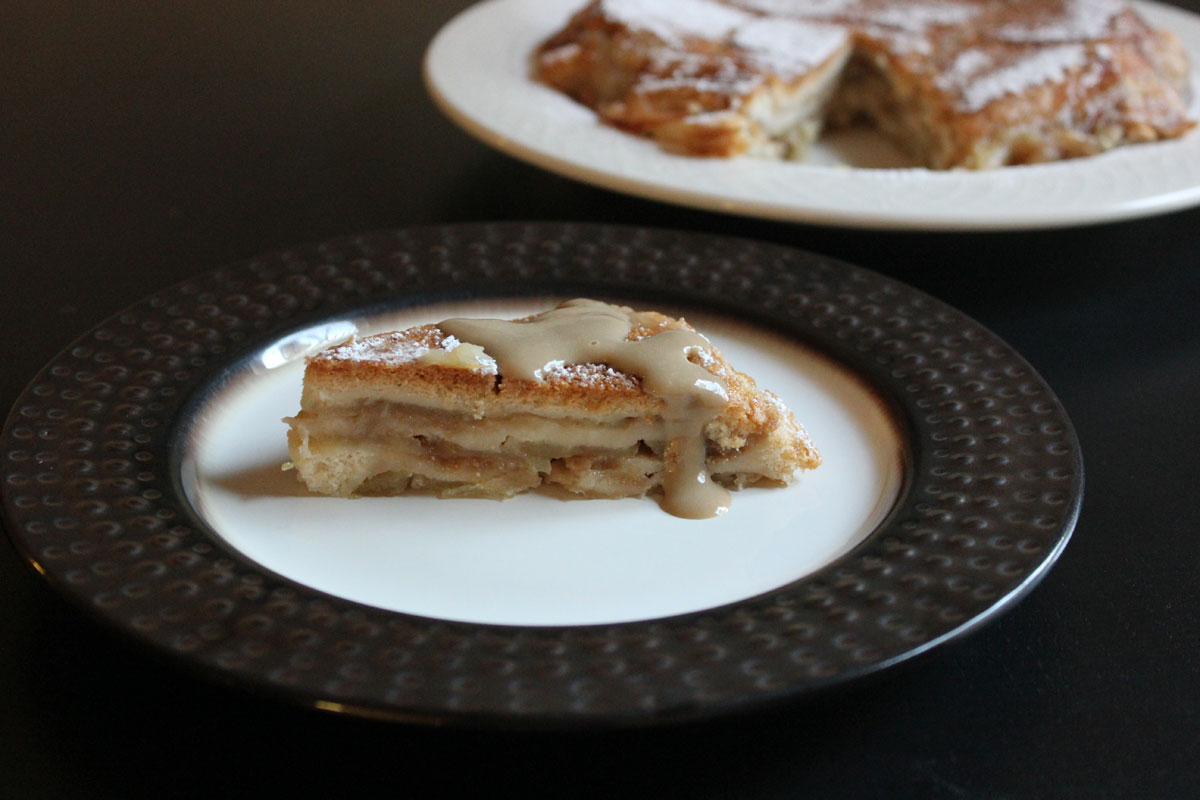
    Though Apple Charlotte never actually got made on Downton Abbey, its absence led to poorly sighted Mrs Patmore’s raspberry meringue, which led to spoonfuls of salt in place of sugar, which led to Sir Anthony Strallan nearly choking and Lady Grantham with one of her Lady Granthamest lines ever: Bring fruit, bring cheese, bring anything to take this taste away!

    I made a recipe from Mrs Beeton’s Book of Household Management, an extensive guide first published in 1861 by Isabella Beeton, and the standard for all English households from the Victorian era onward. Served with a lovely Lady Grey creme anglaise; it’s like Earl Grey but it’s for ladies.

    Apple Charlotte

    Adapted from Mrs. Beeton’s Book of Household Management

    • About 6 large slices bread, crusts cut off and buttered, more if needed
    • About 2 large Granny Smith apples, peeled, cored, and thinly sliced, more if needed
    • 3 pinches of salt
    • zest of one lemon
    • 3 heaping tablespoons brown sugar

    Heat oven to 350°

    Butter a pie pan. Tear large pieces of bread and place in a single layer. Arrange a layer of apple slices on top, then sprinkle with a pinch of salt, a third of the lemon zest, and a heaping tablespoon of brown sugar. Repeat for the other two layers. Gently press down and cover with foil.

    Bake for 45 minutes to an hour (I checked at 45, the apples were cooked but firm, by an hour they were cooked down properly).

    Allow to cool, then overturn on a plate, sprinkle with powdered sugar, and serve with vanilla ice cream, or creme anglaise (recipe follows).

    Lady Grey Creme Anglaise

    Adapted from Biscayenne

    • 3/4 cup milk
    • 1 teaspoon vanilla extract
    • 2 Lady Grey tea bags
    • 2 egg yolks
    • 1/4 cup sugar

    Bring milk, vanilla and tea bags to a simmer, then remove from heat and steep 10 minutes. Remove tea bags (after squeezing out the liquid).

    Meanwhile, whisk egg yolks and sugar until mixture is pale yellow. Pour half the milk mixture into the eggs, whisking constantly. Pour everything back into the sauce pan and reheat over medium heat, constantly stirring, until mixture has thickened. Do not boil. It is ready when it coats a spoon, and you can run your finger over the creme and the trail remains.

    Pour into a bowl placed into a larger bowl of ice and stir until the sauce is cool. Refrigerate to thicken further.

    Recipe for Fiction Kitchen Episode 8: DOWNTON ABBEY in which Diana and Carrie discuss Downton Abbey in its Edwardian glory, including Mrs. Beeton, food styling, frozen gravy, Mrs. Patmore’s dark side, and the best table scraps in Yorkshire.

    Ms Beeton Desserts Downton Abbey

    Illustration from Mrs Beeton’s

    Love apples? Try:

  • Queen of Hearts Strawberry Tarts

    Queen of Hearts Strawberry Tarts

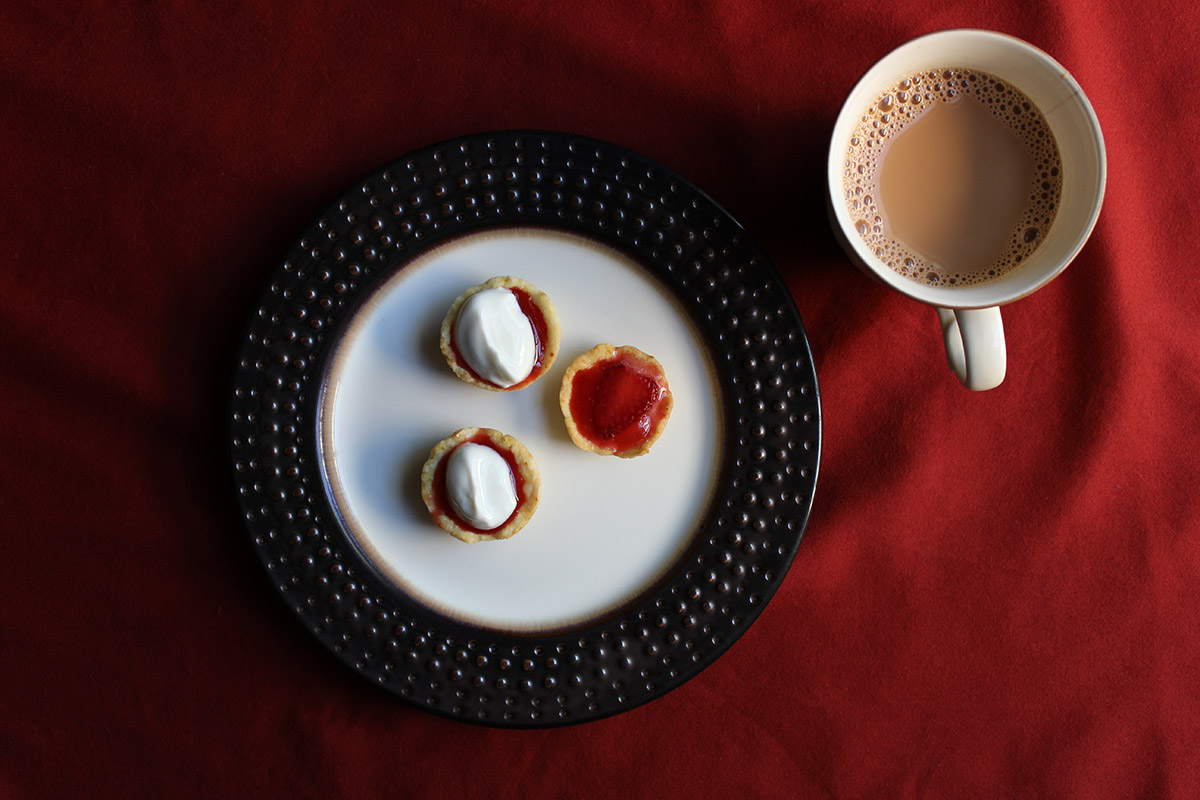
    The Queen of Heart’s stolen tarts cause a lot of drama in Alice in Wonderland, including a wacky trial and much threat of beheading. You can enjoy these with a very calm and reasonable afternoon tea – as long as you remember to paint them red!!

    I made a strawberry curd similar to the lemon curd that I used for Sansa’s Lemoncakes, and topped that with a slice of strawberry and some bright red strawberry glaze. On Fiction Kitchen podcast’s Alice in Wonderland episode I mentioned that if I had it to do again, I would probably either just put the glaze in a thin layer, or else forgo the glaze and pile them up a little more with strawberries brushed with a simple syrup – either I think would be good. However, after a day or two of leftovers, my heart softened to this style (I put less cornstarch than most recipes, so it’s not so gelatinous), so a couple of slices with glaze is also an option.

    The strawberry curd and strawberry glaze recipes below make WAY more than you will need for these mini tarts, so you also have some options there – either make a large tart instead of mini tarts, halve the recipes, or else just enjoy the leftovers. Recommendation for extra strawberry curd: spread on top of muffins, toast or bagels. Recommendation for extra strawberry glaze: stirred into plain yogurt or poured on top of pancakes (along with some fresh strawberries of course).

    Beautiful illustration by Valerie Bastille

    Queen of Hearts Tarts

    For the dough
    Adapted from Sandra Gutierrez’s Butter Pie Crust

    • 2 cups all-purpose flour
    • 1 teaspoon salt
    • 1 tablespoon sugar
    • zest of one orange
    • 1/2 cup very cold unsalted butter, cut into 1-inch cubes
    • 4 to 6 tablespoons ice water

    Butter a mini muffin tin (or mini tart pan if you possess such a thing).

    In a food processor, combine flour, salt, sugar, orange zest, and butter, until the mixture looks grainy. Add in just enough water that when combined it makes a dough. Turn out onto a floured board or counter, and roll about 1/8 of an inch thick. Cut circles (I used the top of a mason jar) and press them into the prepared muffin tin, making as nice an edge as you can manage. Cover with plastic wrap and let sit in the fridge at least 30 minutes.

    For the strawberry curd
    Adapted from Ina Garten

    • 16 tablespoons (2 sticks) butter
    • 1 1/2 cups sugar
    • zest of 2 lemons
    • 4 eggs
    • juice of 1 lemon and half an orange
    • 1/4 cup pureed strawberries
    • 1/8 tsp salt

    Cream the butter, then beat in the sugar and lemon zest. Add the eggs one by one. In a blender, combine lemon and orange juices, strawberries, and salt and blend thoroughly. Press through a fine mesh strainer then combine with butter/sugar mixture.

    Pour into a saucepan and cook VERY SLOWLY over low heat, stirring, until thickened (10 minutes or so, mine took longer – it will thicken just below boiling point). Remove from heat and cool completely.

    For the strawberry glaze

    • 1 heaping cup strawberries
    • 1/2 cup sugar
    • 2 tablespoons cornstarch

    (Full disclosure, I sliced the strawberries and let them sit in sugar for 10 minutes beforehand to release the juices – it’s all going the same place though so this might have been unnecessary). Blend strawberries, sugar, and 3/4 cup water and push through a fine mesh strainer into a sauce pan. Cook on medium low heat, stirring, until thicken, then remove from heat.

    To finish
    Prick the pie crusts and bake in a 350° oven until golden brown. (You’ll just bake the crusts, not the filling). Remove from the oven and spoon half to 3/4 full of lemon curd, then top with your choice of just glaze, or strawberries (slices or halves) brushed with glaze. Cool completely. You can store them in the fridge.

    Serve with barely sweetened yogurt or whipped cream.

    Recipe for Fiction Kitchen Episode 13: Alice in Wonderland in which Diana and Carrie discuss Lewis Carroll’s delightfully nonsensical novel, the 1951 Disney adaptation, and several others. Join us! For what use is a book without pictures or conversation?

  • Juniper and Almond Baked Apples

    Juniper and Almond Baked Apples

    “The Juniper Tree” (full story below) is one of the darker stories from Grimm’s Fairy Tales, and as a dark little kid it was unsurprisingly one of my favorites. I wrote and performed it as a puppet show in middle school, a puppet got decapitated and everything! It’s got all the classic Grimm motifs: the wish of a mother, an oblivious father, a wicked stepmother, burial beneath a tree, a magical bird, the eating of children, one character inexplicably getting a name while no one else does, weird verse, violent demise and a happy rebirth.


    Lovely illustration by Sirothello

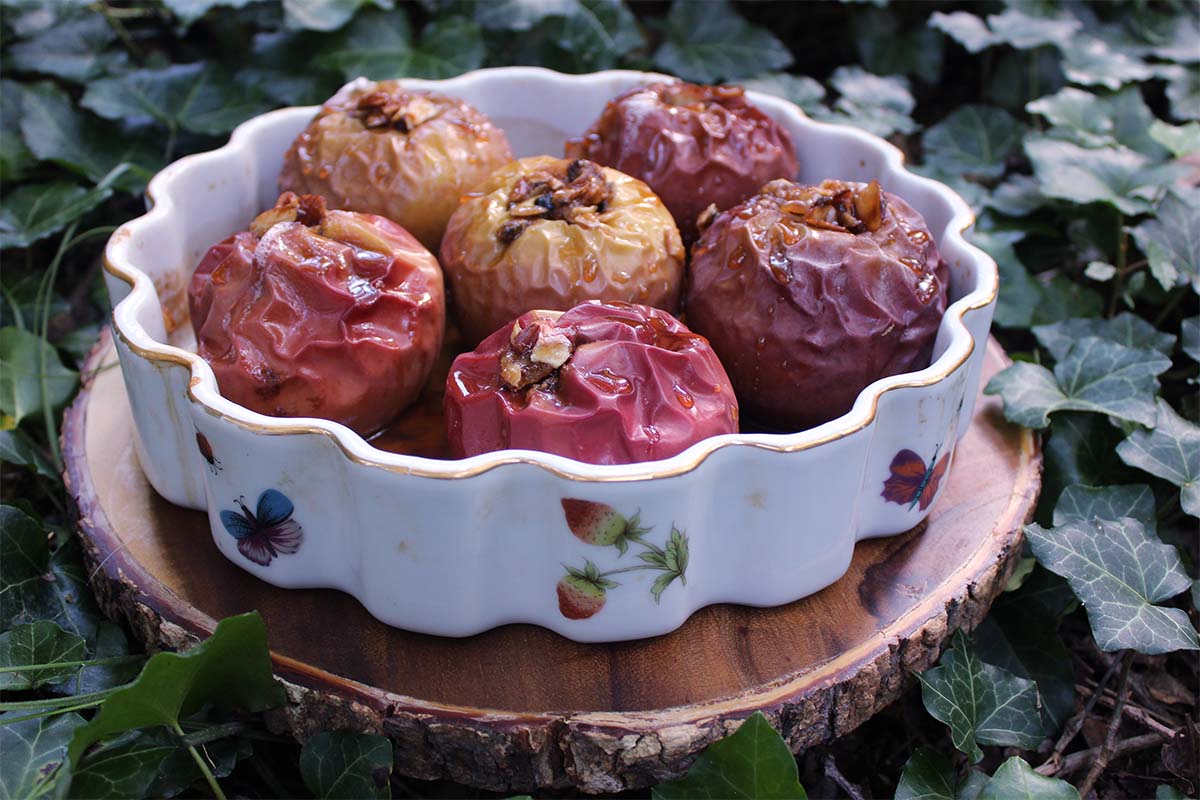
    These baked apples are flavored with piney-scented juniper berries, and taste like Christmas. I referenced this recipe which uses pine nuts and sounds delicious, but I used almonds as a nod to “The Almond Tree,” (as “The Juniper Tree” is called in some editions); honestly any nuts will do. And I cook them DOWN – they’re not as pretty as some baked apples, they’re wrinkly as an old witch, but they’re cooked nice and soft all the way through.

    Juniper and Almond Baked Apples

    • 6 medium-small Macintosh apples
    • 1/2 cup brown sugar
    • 1 teaspoon juniper berries, crushed
    • 2 tablespoons melted butter
    • pinch salt
    • 1/2 cup almond slices
    • 1/4 teaspoon cinnamon
    • 1 teaspoon orange zest
    • 2 teaspoons orange juice
    • 1/2 cup sherry
    • 1/2 cup water

    Heat oven to 350°

    Core the apples and place in a baking dish. Mix together the brown sugar, crushed juniper berries, butter, salt, almond slivers, all spice, orange zest, and 1 1/2 teaspoons of the orange juice. Spoon the mixture into the apples (it’s ok if you have some leftover, ours fit perfectly).

    Pour sherry and water over apples along with any leftover sugar/almond mixture. Bake for 45 minutes or until apples are soft. Check occasionally to make sure almonds don’t burn; if they start to you can tent the dish with foil.

    Optional but recommended: cool for 10 minutes or so, then carefully pour the liquid from the baking dish into a sauce pan. Cook, reducing to about a quarter of the volume, cool, and use as a drizzle when serving. Serve apples warm with whipped cream or ice cream.

    Recipe for Fiction Kitchen Episode 6: GRIMM’S FAIRY TALES in which Carrie and Diana discuss German cultural identity, DNA of fairy tales, commonplace starvation, herbal abortion, the beautiful imagery of a handless maiden eating a pear, and lots of recipes and recipe ideas.

    The Juniper Tree

    Long ago, at least two thousand years, there was a rich man who had a beautiful and pious wife, and they loved each other dearly. However, they had no children, though they wished very much to have some, and the woman prayed for them day and night, but they didn’t get any, and they didn’t get any.

    In front of their house there was a courtyard where there stood a juniper tree. One day in winter the woman was standing beneath it, peeling herself an apple, and while she was thus peeling the apple, she cut her finger, and the blood fell into the snow.

    “Oh,” said the woman. She sighed heavily, looked at the blood before her, and was most unhappy. “If only I had a child as red as blood and as white as snow.” And as she said that, she became quite contented, and felt sure that it was going to happen.

    Then she went into the house, and a month went by, and the snow was gone. And two months, and everything was green. And three months, and all the flowers came out of the earth. And four months, and all the trees in the woods grew thicker, and the green branches were all entwined in one another, and the birds sang until the woods resounded and the blossoms fell from the trees. Then the fifth month passed, and she stood beneath the juniper tree, which smelled so sweet that her heart jumped for joy, and she fell on her knees and was beside herself. And when the sixth month was over, the fruit was thick and large, and then she was quite still. And after the seventh month she picked the juniper berries and ate them greedily. Then she grew sick and sorrowful. Then the eighth month passed, and she called her husband to her, and cried, and said, “If I die, then bury me beneath the juniper tree.” Then she was quite comforted and happy until the next month was over, and then she had a child as white as snow and as red as blood, and when she saw it, she was so happy that she died.

    Her husband buried her beneath the juniper tree, and he began to cry bitterly. After some time he was more at ease, and although he still cried, he could bear it. And some time later he took another wife.

    He had a daughter by the second wife, but the first wife’s child was a little son, and he was as red as blood and as white as snow. When the woman looked at her daughter, she loved her very much, but then she looked at the little boy, and it pierced her heart, for she thought that he would always stand in her way, and she was always thinking how she could get the entire inheritance for her daughter. And the Evil One filled her mind with this until she grew very angry with the little boy, and she pushed him from one corner to the other and slapped him here and cuffed him there, until the poor child was always afraid, for when he came home from school there was nowhere he could find any peace.

    One day the woman had gone upstairs to her room, when her little daughter came up too, and said, “Mother, give me an apple.”

    “Yes, my child,” said the woman, and gave her a beautiful apple out of the chest. The chest had a large heavy lid with a large sharp iron lock.

    “Mother,” said the little daughter, “is brother not to have one too?”

    This made the woman angry, but she said, “Yes, when he comes home from school.”

    When from the window she saw him coming, it was as though the Evil One came over her, and she grabbed the apple and took it away from her daughter, saying, “You shall not have one before your brother.”

    She threw the apple into the chest, and shut it. Then the little boy came in the door, and the Evil One made her say to him kindly, “My son, do you want an apple?” And she looked at him fiercely.

    “Mother,” said the little boy, “how angry you look. Yes, give me an apple.”

    Then it seemed to her as if she had to persuade him. “Come with me,” she said, opening the lid of the chest. “Take out an apple for yourself.” And while the little boy was leaning over, the Evil One prompted her, and crash! she slammed down the lid, and his head flew off, falling among the red apples.

    Then fear overcame her, and she thought, “Maybe I can get out of this.” So she went upstairs to her room to her chest of drawers, and took a white scarf out of the top drawer, and set the head on the neck again, tying the scarf around it so that nothing could be seen. Then she set him on a chair in front of the door and put the apple in his hand.

    After this Marlene came into the kitchen to her mother, who was standing by the fire with a pot of hot water before her which she was stirring around and around.

    “Mother,” said Marlene, “brother is sitting at the door, and he looks totally white and has an apple in his hand. I asked him to give me the apple, but he did not answer me, and I was very frightened.”

    “Go back to him,” said her mother, “and if he will not answer you, then box his ears.”

    So Marlene went to him and said, “Brother, give me the apple.” But he was silent, so she gave him one on the ear, and his head fell off. Marlene was terrified, and began crying and screaming, and ran to her mother, and said, “Oh, mother, I have knocked my brother’s head off,” and she cried and cried and could not be comforted.

    “Marlene,” said the mother, “what have you done? Be quiet and don’t let anyone know about it. It cannot be helped now. We will cook him into stew.”

    Then the mother took the little boy and chopped him in pieces, put him into the pot, and cooked him into stew. But Marlene stood by crying and crying, and all her tears fell into the pot, and they did not need any salt.

    Then the father came home, and sat down at the table and said, “Where is my son?” And the mother served up a large, large dish of stew, and Marlene cried and could not stop.

    Then the father said again, “Where is my son?”

    “Oh,” said the mother, “he has gone across the country to his mother’s great uncle. He will stay there awhile.”

    “What is he doing there? He did not even say good-bye to me.”

    “Oh, he wanted to go, and asked me if he could stay six weeks. He will be well taken care of there.”

    “Oh,” said the man, “I am unhappy. It isn’t right. He should have said good-bye to me.” With that he began to eat, saying, “Marlene, why are you crying? Your brother will certainly come back.”

    Then he said, “Wife, this food is delicious. Give me some more.” And the more he ate the more he wanted, and he said, “Give me some more. You two shall have none of it. It seems to me as if it were all mine.” And he ate and ate, throwing all the bones under the table, until he had finished it all.

    Marlene went to her chest of drawers, took her best silk scarf from the bottom drawer, and gathered all the bones from beneath the table and tied them up in her silk scarf, then carried them outside the door, crying tears of blood.

    She laid them down beneath the juniper tree on the green grass, and after she had put them there, she suddenly felt better and did not cry anymore.

    Then the juniper tree began to move. The branches moved apart, then moved together again, just as if someone were rejoicing and clapping his hands. At the same time a mist seemed to rise from the tree, and in the center of this mist it burned like a fire, and a beautiful bird flew out of the fire singing magnificently, and it flew high into the air, and when it was gone, the juniper tree was just as it had been before, and the cloth with the bones was no longer there. Marlene, however, was as happy and contented as if her brother were still alive. And she went merrily into the house, sat down at the table, and ate.

    Then the bird flew away and lit on a goldsmith’s house, and began to sing:

    My mother, she killed me,
    My father, he ate me,
    My sister Marlene,
    Gathered all my bones,
    Tied them in a silken scarf,
    Laid them beneath the juniper tree,
    Tweet, tweet, what a beautiful bird am I.

    The goldsmith was sitting in his workshop making a golden chain, when he heard the bird sitting on his roof and singing. The song seemed very beautiful to him. He stood up, but as he crossed the threshold he lost one of his slippers. However, he went right up the middle of the street with only one slipper and one sock on. He had his leather apron on, and in one hand he had a golden chain and in the other his tongs. The sun was shining brightly on the street.

    He walked onward, then stood still and said to the bird, “Bird,” he said, “how beautifully you can sing. Sing that piece again for me.”

    “No,” said the bird, “I do not sing twice for nothing. Give me the golden chain, and then I will sing it again for you.”

    The goldsmith said, “Here is the golden chain for you. Now sing that song again for me.” Then the bird came and took the golden chain in his right claw, and went and sat in front of the goldsmith, and sang:

    My mother, she killed me,
    My father, he ate me,
    My sister Marlene,
    Gathered all my bones,
    Tied them in a silken scarf,
    Laid them beneath the juniper tree,
    Tweet, tweet, what a beautiful bird am I.

    Then the bird flew away to a shoemaker, and lit on his roof and sang:

    My mother, she killed me,
    My father, he ate me,
    My sister Marlene,
    Gathered all my bones,
    Tied them in a silken scarf,
    Laid them beneath the juniper tree,
    Tweet, tweet, what a beautiful bird am I.

    Hearing this, the shoemaker ran out of doors in his shirtsleeves, and looked up at his roof, and had to hold his hand in front of his eyes to keep the sun from blinding him. “Bird,” said he, “how beautifully you can sing.”

    Then he called in at his door, “Wife, come outside. There is a bird here. Look at this bird. He certainly can sing.” Then he called his daughter and her children, and the journeyman, and the apprentice, and the maid, and they all came out into the street and looked at the bird and saw how beautiful he was, and what fine red and green feathers he had, and how his neck was like pure gold, and how his eyes shone like stars in his head.

    “Bird,” said the shoemaker, “now sing that song again for me.”

    “No,” said the bird, “I do not sing twice for nothing. You must give me something.”

    “Wife,” said the man, “go into the shop. There is a pair of red shoes on the top shelf. Bring them down.” Then the wife went and brought the shoes.

    “There, bird,” said the man, “now sing that piece again for me.” Then the bird came and took the shoes in his left claw, and flew back to the roof, and sang:

    My mother, she killed me,
    My father, he ate me,
    My sister Marlene,
    Gathered all my bones,
    Tied them in a silken scarf,
    Laid them beneath the juniper tree,
    Tweet, tweet, what a beautiful bird am I.

    When he had finished his song he flew away. In his right claw he had the chain and in his left one the shoes. He flew far away to a mill, and the mill went clickety-clack, clickety-clack, clickety-clack. In the mill sat twenty miller’s apprentices cutting a stone, and chiseling chip-chop, chip-chop, chip-chop. And the mill went clickety-clack, clickety-clack, clickety-clack.

    Then the bird went and sat on a linden tree which stood in front of the mill, and sang:

    My mother, she killed me,

    Then one of them stopped working.

    My father, he ate me,

    Then two more stopped working and listened,

    My sister Marlene,

    Then four more stopped,

    Gathered all my bones,
    Tied them in a silken scarf,

    Now only eight only were chiseling,

    Laid them beneath

    Now only five,

    the juniper tree,

    Now only one,

    Tweet, tweet, what a beautiful bird am I.

    Then the last one stopped also, and heard the last words. “Bird,” said he, “how beautifully you sing. Let me hear that too. Sing it once more for me.”

    “No,” said the bird, “I do not sing twice for nothing. Give me the millstone, and then I will sing it again.”

    “Yes,” he said, “if it belonged only to me, you should have it.”

    “Yes,” said the others, “if he sings again he can have it.”

    Then the bird came down, and the twenty millers took a beam and lifted the stone up. Yo-heave-ho! Yo-heave-ho! Yo-heave-ho!

    The bird stuck his neck through the hole and put the stone on as if it were a collar, then flew to the tree again, and sang:

    My mother, she killed me,
    My father, he ate me,
    My sister Marlene,
    Gathered all my bones,
    Tied them in a silken scarf,
    Laid them beneath the juniper tree,
    Tweet, tweet, what a beautiful bird am I.

    When he was finished singing, he spread his wings, and in his right claw he had the chain, and in his left one the shoes, and around his neck the millstone. He flew far away to his father’s house.

    In the room the father, the mother, and Marlene were sitting at the table.

    The father said, “I feel so contented. I am so happy.”

    “Not I,” said the mother, “I feel uneasy, just as if a bad storm were coming.”

    But Marlene just sat and cried and cried.

    Then the bird flew up, and as it seated itself on the roof, the father said, “Oh, I feel so truly happy, and the sun is shining so beautifully outside. I feel as if I were about to see some old acquaintance again.”

    “Not I,” said the woman, “I am so afraid that my teeth are chattering, and I feel like I have fire in my veins.” And she tore open her bodice even more. Marlene sat in a corner crying. She held a handkerchief before her eyes and cried until it was wet clear through.

    Then the bird seated itself on the juniper tree, and sang:

    My mother, she killed me,

    The mother stopped her ears and shut her eyes, not wanting to see or hear, but there was a roaring in her ears like the fiercest storm, and her eyes burned and flashed like lightning.

    My father, he ate me,

    “Oh, mother,” said the man, “that is a beautiful bird. He is singing so splendidly, and the sun is shining so warmly, and it smells like pure cinnamon.”

    My sister Marlene,

    Then Marlene laid her head on her knees and cried and cried, but the man said, “I am going out. I must see the bird up close.”

    “Oh, don’t go,” said the woman, “I feel as if the whole house were shaking and on fire.”

    But the man went out and looked at the bird.

    Gathered all my bones,
    Tied them in a silken scarf,
    Laid them beneath the juniper tree,
    Tweet, tweet, what a beautiful bird am I.

    With this the bird dropped the golden chain, and it fell right around the man’s neck, so exactly around it that it fit beautifully. Then the man went in and said, “Just look what a beautiful bird that is, and what a beautiful golden chain he has given me, and how nice it looks.”

    But the woman was terrified. She fell down on the floor in the room, and her cap fell off her head. Then the bird sang once more:

    My mother killed me.

    “I wish I were a thousand fathoms beneath the earth, so I would not have to hear that!”

    My father, he ate me,

    Then the woman fell down as if she were dead.

    My sister Marlene,

    “Oh,” said Marlene, “I too will go out and see if the bird will give me something.” Then she went out.

    Gathered all my bones,
    Tied them in a silken scarf,

    He threw the shoes down to her.

    Laid them beneath the juniper tree,
    Tweet, tweet, what a beautiful bird am I.

    Then she was contented and happy. She put on the new red shoes and danced and leaped into the house. “Oh,” she said, “I was so sad when I went out and now I am so contented. That is a splendid bird, he has given me a pair of red shoes.”

    “No,” said the woman, jumping to her feet and with her hair standing up like flames of fire, “I feel as if the world were coming to an end. I too, will go out and see if it makes me feel better.”

    And as she went out the door, crash! the bird threw the millstone on her head, and it crushed her to death.

    The father and Marlene heard it and went out. Smoke, flames, and fire were rising from the place, and when that was over, the little brother was standing there, and he took his father and Marlene by the hand, and all three were very happy, and they went into the house, sat down at the table, and ate.
  • Gingerbread

    Gingerbread

    Bored now.

    If Buffy the Vampire Slayer is my one of my all time favorite TV shows (and it is; Buffy has gotten me through some dark times), then Willow Rosenberg is one of my all time favorite characters. Maybe because she’s the closest representations of myself I’ve ever seen in fiction: nerdy, quiet, sweet, smart, witchy – and more darkly: selfish, controlling, with an addictive personality. If this post seems a little me-centric, it is, and I will point out that that too is Willowesque.

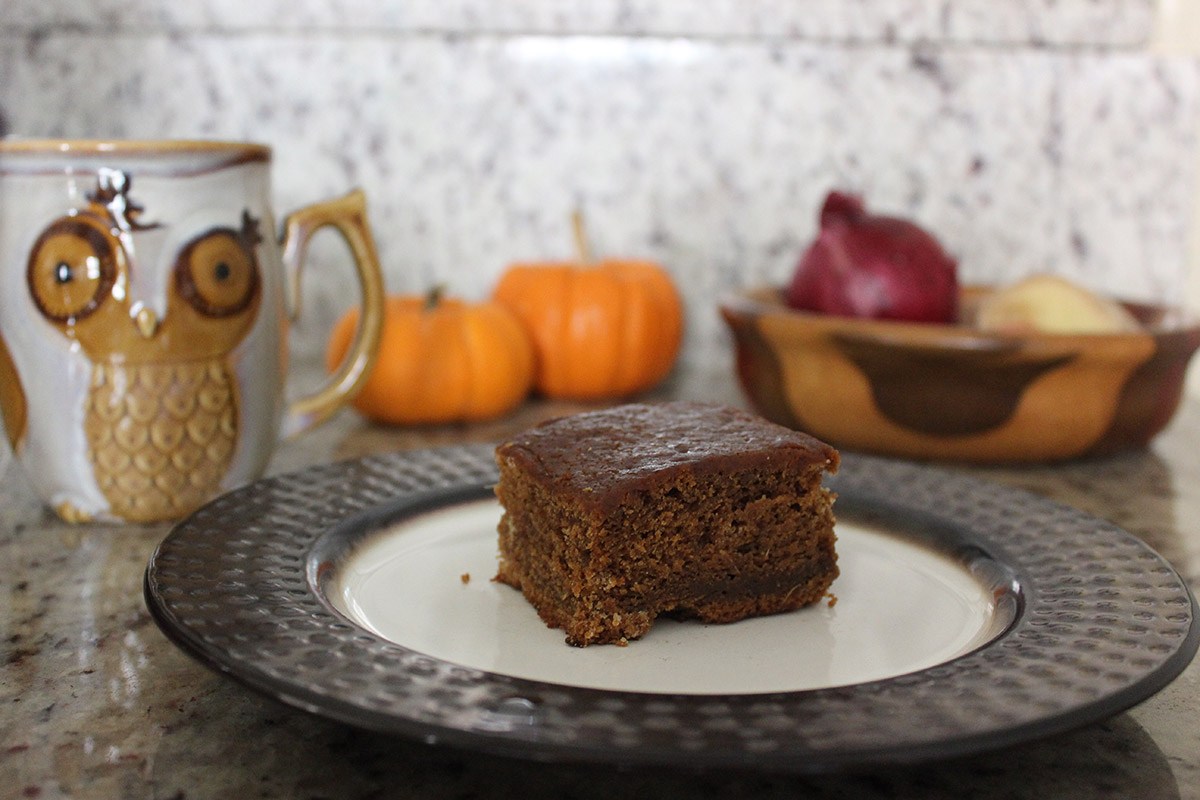
    Gingerbread is not a great, or even that good, episode of Buffy, but it’s one that I remember fondly and think back to often. Maybe because it’s one of the first ones I ever saw, and one of the reasons I started watching the original run, but also because the combination of fairy tales, creepy kids, Willow character development, and a hilarious line by Cordelia about her mom confiscating all her black clothes and scented candles make it a really entertaining one, one close to my little black heart.

    Also it’s the one where Amy turns into a rat.

    Gingerbread

    Adapted from King Arthur Flour

    • 2 1/4 cups all-purpose flour
    • 1 teaspoon baking soda
    • 1/2 teaspoon salt
    • 1 tablespoon Witchy Autumn Spice Mix (or a mixture of spices such as cinnamon, cloves, nutmeg, ginger, etc.)
    • 1/2 cup (1 stick) unsalted butter, melted
    • 3/4 cup molasses
    • 1/4 cup honey
    • 1 tablespoon grated fresh ginger
    • 1 egg
    • 1 cup buttermilk (or allow 1 cup milk with a 1 tablespoon lemon juice to sit for 10 minutes)
    • 1/4 cup water

    Heat oven to 350° and prepare a 9×9 baking pan.

    Whisk together flour, baking soda, salt, and spices. Pour in the melted butter, molasses, and honey (you can combine the molasses and honey in a measuring cup and heat for 20 seconds in the microwave to make it pour easily) and stir gently into the flour until moistened. Add ginger, beaten egg, buttermilk and water and stir gently until evenly combined.

    Pour into baking dish and bake for about 35 minutes (start checking around 33) until cake is pulling away from the edge of the pan.

    Cool on a rack for at least 15 minutes before serving.

    Recipe for Fiction Kitchen Episode 23: BUFFY THE VAMPIRE SLAYER in which Carrie and Diana discuss the cult TV show with various vampy concoctions – Happy Meals on legs, textured blood, yummy sushi, foamy nectar, and some really bad puns. #TeamSpike #Spiffy

  • Donut Gems

    Donut Gems

    Humans just lead short, boring, insignificant lives, so they make up stories to feel like they’re a part of something bigger. They want to blame all the world’s problems on some single enemy they can fight, instead of a complex network of interrelated forces beyond anyone’s control. -Pearl

    Steven Universe is an adorable animated series, always funny, sometimes almost unbearably deep, and often very, very sweet. It explores themes growing up, gender, relationships and acceptance, and of what it means to be a family.

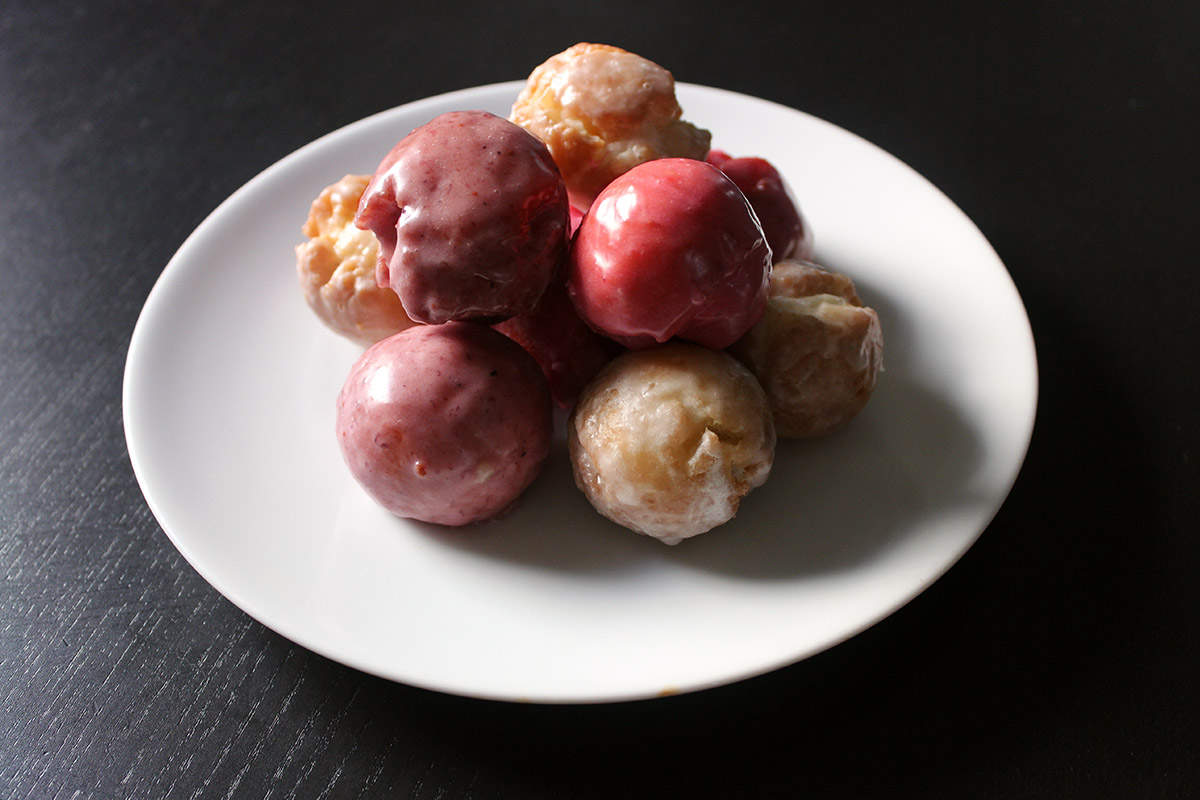
    Because Steven lives next to a donut shop with the Crystal Gems, his aunts Garnet, Amethyst and Pearl, jewel toned donut holes seemed like a fun thing to make! I’m a fan of the cake donuts rather than the traditional yeast type, so that’s the road I went, but what makes these special are the completely simple 2-ingredient glazes. I love mashing berries to mix with powdered sugar, because you get such a lovely color, naturally.

    Donut Gems

    For the sour cream donuts – from Hummingbird High

    • 2 1/4 cups cake flour
    • 1 1/2 teaspoons baking powder
    • 1 teaspoon salt
    • 1/2 cup sugar
    • 2 tablespoons vegetable shortening
    • 2 large egg yolks
    • 1/2 cup sour cream
    • vegetable oil for frying

    Whisk together cake flour, baking powder, and salt. In another bowl, beat sugar and shortening together until sandy, then add the egg yolks and beat until light and fluffy. Add the sour cream and mix, then add the flour mixture and mix until just combined. Transfer to a clean bowl and chill for an hour.

    Heat several inches of vegetable oil. Roll the dough into balls, and fry for several minutes, rolling until browned on all sides. Drain on a paper towel and move to a rack. Glaze while still warm

    For the glazes

    • 1/2 cup raspberries, mashed and strained
    • 1/2 cup blueberries, mashed and strained
    • 1 1/2 tablespoons cream
    • powdered sugar

    Mix each of the liquids (raspberries, blueberries, cream) in separate bowls with enough powdered sugar to make a glaze (should be thick but still liquid, about 1 cup to 1 1/2 cups per mixture).

    Dip warm donut holes in the glaze, turn to coat, and leave to cool on the rack.

    We’ve been swirling leftover glaze into plain yogurt 🙂

    This dish was first posted for Fiction Kitchen Episode 41: STEVEN UNIVERSE in which Carrie and Diana discuss the animated series and many munchies, including dognuts, fry bits, cookie cats, transfats, chaps, free napkins, and together breakfasts.

  • Rosy Lemon Cakes

    Rosy Lemon Cakes

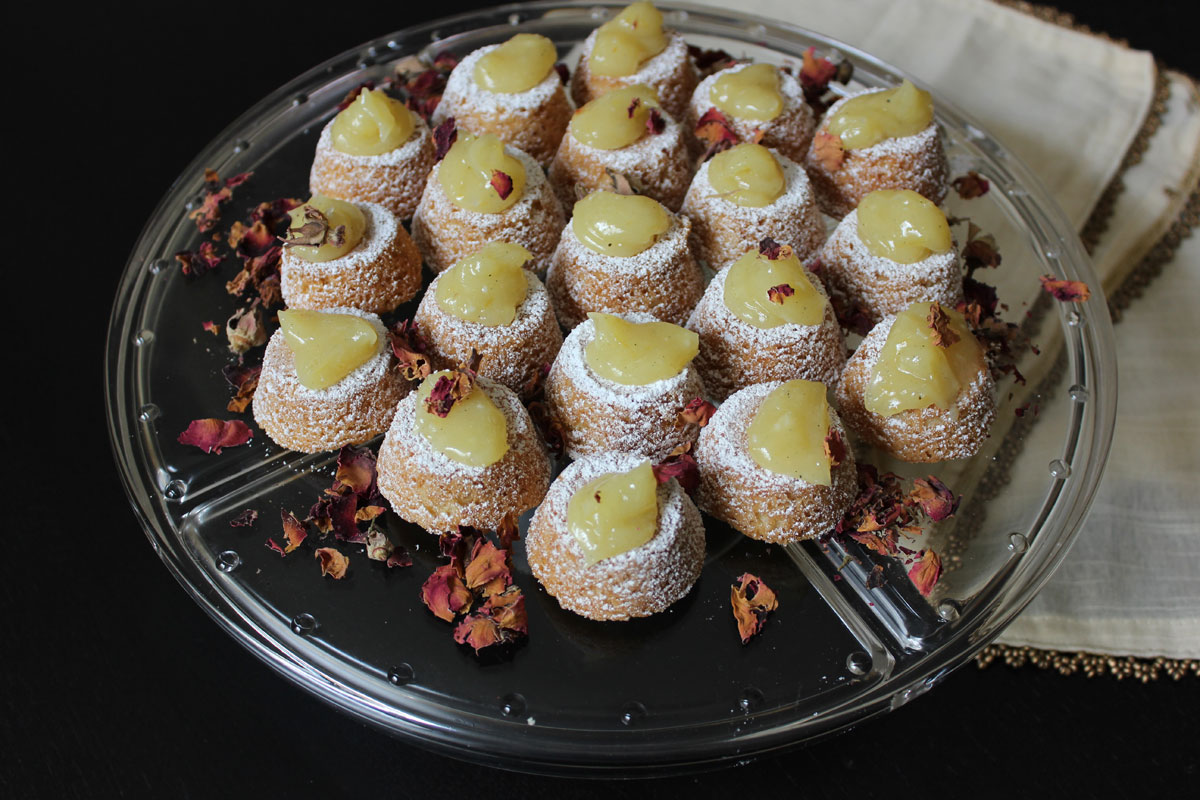
    I had a very specific image of Sansa’s favorite treat in mind as I was reading Game of Thrones, so it took a couple of tries to get them right! I had a vision of small, almost bite-sized cakes on a platter, decorated prettily. I wanted them very dense, barely leavened, so I melted the butter and cooked them at a very low temperature. There are a million lemon cake recipes floating around, so I’ve tried what I imagined as regional variations. This one is inspired by Highgarden. I used rosewater in both the lemon curd and the lemon cakes; the Tyrell’s sigil is the Rose, which I thought was fitting as Marjorie was a decent ally for awhile to Sansa.

    As a variation, I also made a Queen in the North version: Rosemary Lemon Cakes with rosemary and candied lemon.

    Rosy Lemon Cakes

    For the rosy lemon curd
    Adapted from Ina Garten

    • 16 tablespoons (2 sticks) butter
    • 1 1/2 cups sugar
    • zest of 3 lemons
    • 4 eggs
    • juice of 2 lemons
    • 2 tbsp rose water
    • 1/8 tsp salt

    Cream the butter, then beat in the sugar and lemon zest. Add the eggs one by one, then the lemon juice, rosewater, and salt.

    Pour into a saucepan and cook over low heat, stirring, until thickened (10 minutes or so, mine took longer). Remove from heat and cool completely. Can save in the fridge.

    For the lemon cakes

    • 6 tablespoons butter, melted
    • 1/3 cup honey
    • 3 egg yolks
    • 2 tablespoons lemon juice
    • 2 tablespoons rosewater
    • pinch safflower for color (optional)
    • 1 1/4 cups all purpose flour (spoon very lightly into measuring cups to measure)
    • 1/2 teaspoon baking soda
    • 1/2 teaspoon salt
    • powdered sugar, rosy lemon curd, and optional rose petals to decorate

    Heat oven to 275°

    Whisk together well butter and honey, then whisk in egg yolks one at a time. Whisk in lemon juice, rosewater, and crumbled safflower.

    In a separate bowl, mix flour, baking soda and salt, then stir into wet ingredients until just combined. Spoon into greased mini muffin cups, and bake for 15-17 minutes, until a toothpick comes out clean.

    Cool for a few minutes in the pan, then overturn onto a plate to cool the rest of the way. Before serving, sprinkle with powdered sugar, dollop with lemon curd, and garnish with a few sprinkled rose petals.

    This is kind of an amalgam of these:
    Fine Cakes translated by Gode Cookery
    Medieval Lemon Cakes by Inn at the Crossroads
    Lemoncakes from Geeky Chef (this is my favorite presentation, I may try the ones above again with just little lemon slices in the muffin cups)

    This dish was first posted for Fiction Kitchen Episode 1: GAME OF THRONES in which Carrie and Diana discuss characters, regions and cuisines of Westeros and Essos, salt rite, food styling, and blood and boobs.

  • Prune Kouign Amann

    Prune Kouign Amann

    This month’s Fandom Foodies theme, hosted by The Hungry Bookworm, is Magical Realism, one of my favorite genres of fiction – and let’s be honest, the one I wish I was living in. Find lots of magical realism dishes using #MagicalRealFood.

    Amélie is an adorably quirky film, one of my favorites of all time. Romantic and twee, and even a bit dark at times, it’s a movie for dreamers – and times are hard for dreamers.

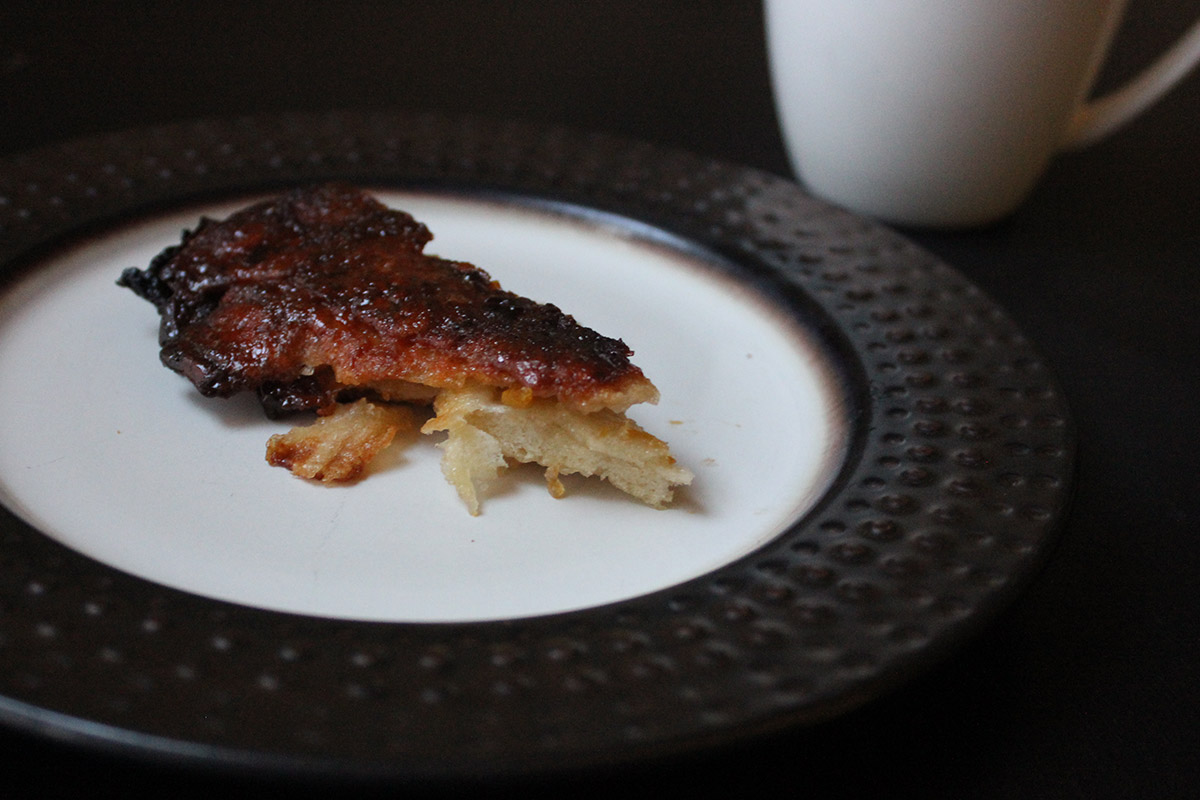
    In a sweetly heartbreaking scene, Amélie does what a lot of us do when miserable which is sad-baking. For her that means her famous plum cake. I never really knew what her plum cake was supposed to be, only that it was a yeast cake which seemed interesting and unusual. On latest viewing I dug into it a little and was introduced to kouign amann, a cake from Brittany, that is made with a yeast dough, and then folded and rolled into layers of butter and sugar, then baked until it is nice caramelized. With all the folding and layering, there’s opportunity for fillings, such as chocolate, cinnamon, jam, or fresh fruit.

    For my first try, this wasn’t bad. Lessons to take away:

    • It was a little dense, so next time I might try my pizza dough method, which is to add the flour gradually until it juuuuuust makes a dough, rather than add it all at once.
    • Also, as you can see, caramelization is good, but there’s always too much of a good thing – I’ve complained before about my oven running hot (and yet, forgot to check how things were going along the way), so my cake got veeeery caramelized, and even a little burnt in spots. Next time I’ll lower the heat a bit and babysit it a little better.
    • Finally, as plums are not in season I used plum preserves, which was definitely tasty, but a little messy as it leaked out of the dough, onto my counters, and into the oven as well (I had to slide a sheet pan underneath to catch the drips). While this is still a legit version, I’m excited to try it with fresh fruit, so that’s the plan come July or August.

    Amelie’s Famous Plum Cake (Prune Kouign Amann)

    Rather than transcribe the entire recipe, I’m just going to link to David Leibovitz’s as I pretty much did that exactly, and he has very detailed instructions as well as pictures along the way (the folding pattern can get a little confusing without a visual).

    The only thing I did differently was replacing one of the 1/4 cups of sugar with several tablespoons of plum preserves. Again, just a note, that you may have to adjust temperature and cooking time to your oven.

    Recipe for Kouign Amann

    This dish was first posted for Fiction Kitchen Episode 38: AMELIE in which Carrie and Diana discuss the 2001 French film in which times are hard for dreamers, but things work out ok. Plus, cherry earrings, cracking crème brûlée, plum cake, endives, and scribbles for nibbles.

  • Apple Tansey with Goat Cheese Cream

    Apple Tansey with Goat Cheese Cream

    Wouldst thou like the taste of butter? A pretty dress? Wouldst thou like to live deliciously?

    It’s #Witchtober, hosted by Fiction Food Café. Check the tag on social media for wickedly witchy recipes!

    The Witch (2015), a “New-England Folktale” written and directed by Robert Eggers, is haunting, unsettling, and painstakingly historically accurate. From the dialog to the clothing to the Puritanical hysteria, the colonial ambience is on point. I’ve read several times how it’s not very scary, however (light spoilers) with actual baby-smashing witches, creepy twins, writhing possession and a goat which is terrifying even in its most mundane state – I respectfully ask what more do you want?

    The family dynamic in this movie is refreshing. It could have easily been a story about religious authoritarian parents repressing their daughter who is on the cusp of womanhood. Instead, though devout, they are a family who truly cares about one other and are trying their best both to live righteously and survive in a harsh new land. The parents are both Game of Thrones alums, Ralph Ineson of the low booming voice, and Kate Dickie who has the market cornered on disturbing breastfeeding scenes. Anya Taylor-Joy as Thomasin, the oldest daughter, is fresh and earnest in the face of unknown evil. Bonus points to Black Phillip for exceptional goat acting.

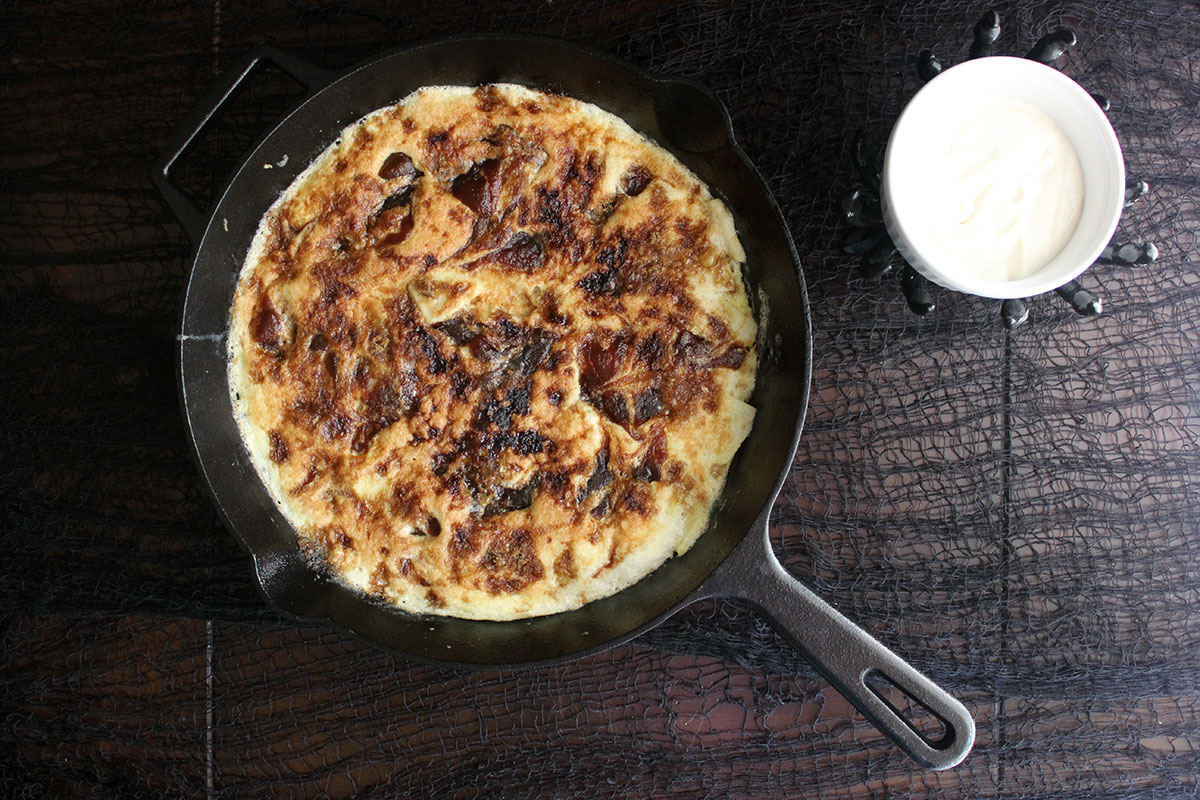
    I made a classic colonial dish, Apple Tansey, based of a recipe that can be found in The Compleat Housewife, first published in London in 1727 and the first cookbook to be published in the United States. A tansey is basically an egg-based dessert, and this one contains apples (and apple butter) which the children in the movie reminisce about eating back in England. The apples are cooked in plenty of butter of course, the luxury so unctuously uttered into Thomasin’s ear, and served with a lightly sweetened goat cheese cream to honor our king of sky and land, sea and sand, Black Phillilp. Wouldst thou like to live deliciously? Read onward.

    Apple Tansey with Goat Cheese Cream

    For the tansey

    • 2 Granny Smith apples, peeled, cored, halved and sliced
    • 3 tablespoons butter
    • 4 eggs, separated
    • 3 tablespoons sour cream
    • 1 tablespoon sugar
    • 1/4 cup apple butter, store bought or homemade
    • 3 tablespoons brown sugar

    Heat the broiler. On the stovetop in a cast iron skillet or other deep oven-proof pan, melt butter, and cook apple slices on medium until softened (7-10 minutes). Meanwhile, whisk egg yolks with sour cream and sugar, whip egg whites until white and frothy and fold into the egg mixture. Lower heat to medium low and stir egg mixture into apples with a spatula and smooth on top. Swirl in the apple butter and cook for 4-5 minutes until set. Sprinkle with brown sugar and place under the broiler until brown and bubble. Cool slightly before serving with goat cheese cream.

    For the goat cheese cream

    • 4 ounces goat cheese, room temperature
    • 1/4 cup heavy cream
    • 1 tablespoon sugar

    Whip goat cheese until smooth. Separately, whip cream to soft peaks, then blend with goat cheese and sugar until smooth. Serve with the tansey.

  • Princess Peach Cakes

    Princess Peach Cakes

    This month’s Fandom Foodies theme is #MarioMonth, hosted by Lvl.1 Chef. There are so many cute and creative recipes this month inspired by our favorite brick-busting, turtle-tossing, tanooki-suited Italian plumber!

    I had an idea to remix Swedish princess cakes (prinsesstårta) into something a little peachier. Full-size and layered felt a little daunting, so I took a cue from My Name is Yeh and made mini ones – very cute and much less fussy! I made a vanilla cake spread with a lovely peachy compote, then topped with vanilla whipped cream and marzipan – little cakes fit for a princess!

    I also used this as an opportunity to try making marzipan; The Daring Gourmet has a detailed recipe, and as promised, it was really easy to make. Mine did crack a little as I lay it over the cakes – I read some tricks afterwards about how to avoid this, such as not over-kneading and drying out the marzipan, rolling it thin enough so it doesn’t pull, greasing your work surface with Crisco instead of powdered sugar. Regardless, I think they came out super adorable if not super profesh – hey, I can bring the competence, but if you’re looking for expertise, sorry, that princess is in another castle!

    Princess Peach Cakes

    For the cake

    Recipe from Martha Stewart, I chose this spongy one because it has no butter so stays soft when chilled

    • 1 cup flour
    • pinch of salt
    • 1/2 teaspoon baking powder
    • 4 eggs, separated
    • 1 cup sugar
    • 3 tablespoons boiling water
    • 1 vanilla bean, split and scraped

    Line a 9×13 pan with parchment. Sift together flour, salt, and baking powder. Beat together egg yolks and sugar until light and fluffy. Beat in water and vanilla bean scrapings. Add dry ingredients and mix in with a spatula until just combined. Beat egg whites until stiff and fold into batter. Pour into pan and bake at 350° for 15-20 minutes. Cool, remove from pan and wrap in plastic and freeze for at least an hour and up to overnight.

    For the cardamom peach compote

    • 10 ounces frozen peach slices (you can use fresh if in season
    • 4 tablespoons sugar
    • seeds of 3 cardamom pods

    Combine peaches, sugar, and cardamom in a sauce pan and heat on medium heat, stirring occasionally and smashing gently with a wooden spoon, until peaches are thick and mostly broken down (leave some intact for texture). Chill in the fridge.

    For the vanilla whipped cream

    • 1 cup heavy whipping cream
    • 4 tablespoons powdered sugar
    • 1 teaspoon vanilla extract

    Whip together until stiff peaks form

    For the marzipan

    • 1 3/4 cups almond meal
    • 1 3/4 cups powdered sugar
    • 2 teaspoons almond extract
    • 1 teaspoon rose water
    • 1 egg white

    In a food processor, pulse together almon meal and powdered sugar. Add almond extract, rose water, and egg white and combine until a dough forms. Turn it out onto a surface dusted with powdered sugar and knead just a bit until it balls together. You can add food coloring to decorate.

    To assemble the cakes

    Cut six 3-inch circles from the sheet cake (save the scraps to dunk in coffee). Spread each with peach compote, and pipe whipped cream on top. Roll out the marzipan to a thin, even layer (I did mine in two batches), and cut 5 inch circles (I used a bowl). Form over the tops of the cakes. Decorate with artsy craftsy marzipan crowns.

  • Swedish Cinnamon Rolls

    Swedish Cinnamon Rolls

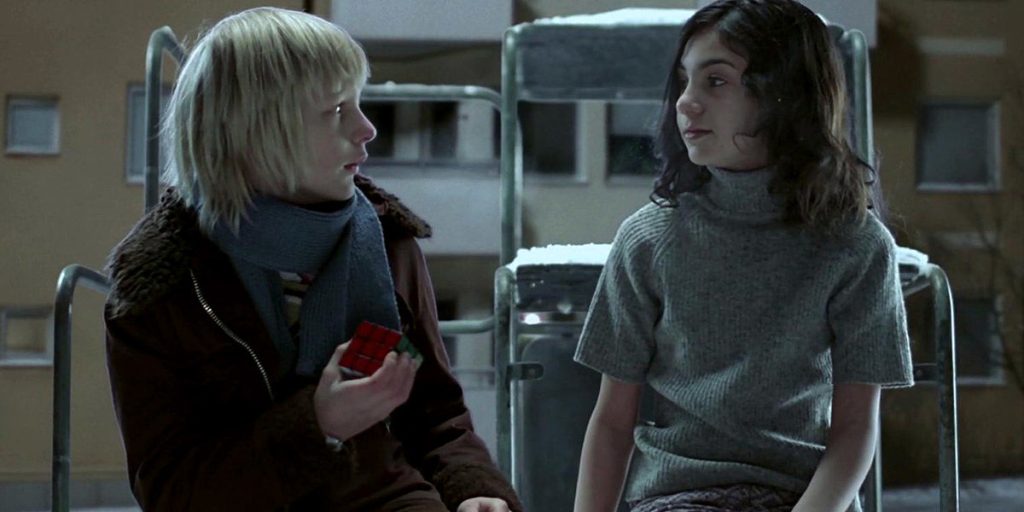
    I saw and loved the Swedish vampire film Let the Right One In for the first time around the time it came out in 2008, but just recently read the book by John Ajvide Lindqvist. These are the August picks for Coffee and Casseroles’ Night Bleeds Book and Movie Club!

    The movie is very good, but as is to be expected, the book adds layers to Eli and Oskar, both to their characters (Oskar is even more of a little shit in the book and Eli even more beautifully tragic) and to their dark friendship. There’s also interesting story around Virginia and Jocke; their plot points are hit in the movie, but there is a lot of detail in the book that is either very sweet or sickly fascinating.

    the-dark-friendship-of-oskar-and-eli-in-let-the-right-one-in-472549

    In the book, Oskar’s mom is a single parent, lonely, relishing his misery and becoming resentful when he makes a friend. Often in the evenings they watch television together and have cinnamon rolls and hot chocolate, a ritual he falls out of when he starts spending more time with Eli. Although in the book these are the Cinnamon Rolls of Gross Codependency, in life these cinnamon rolls are delicious.

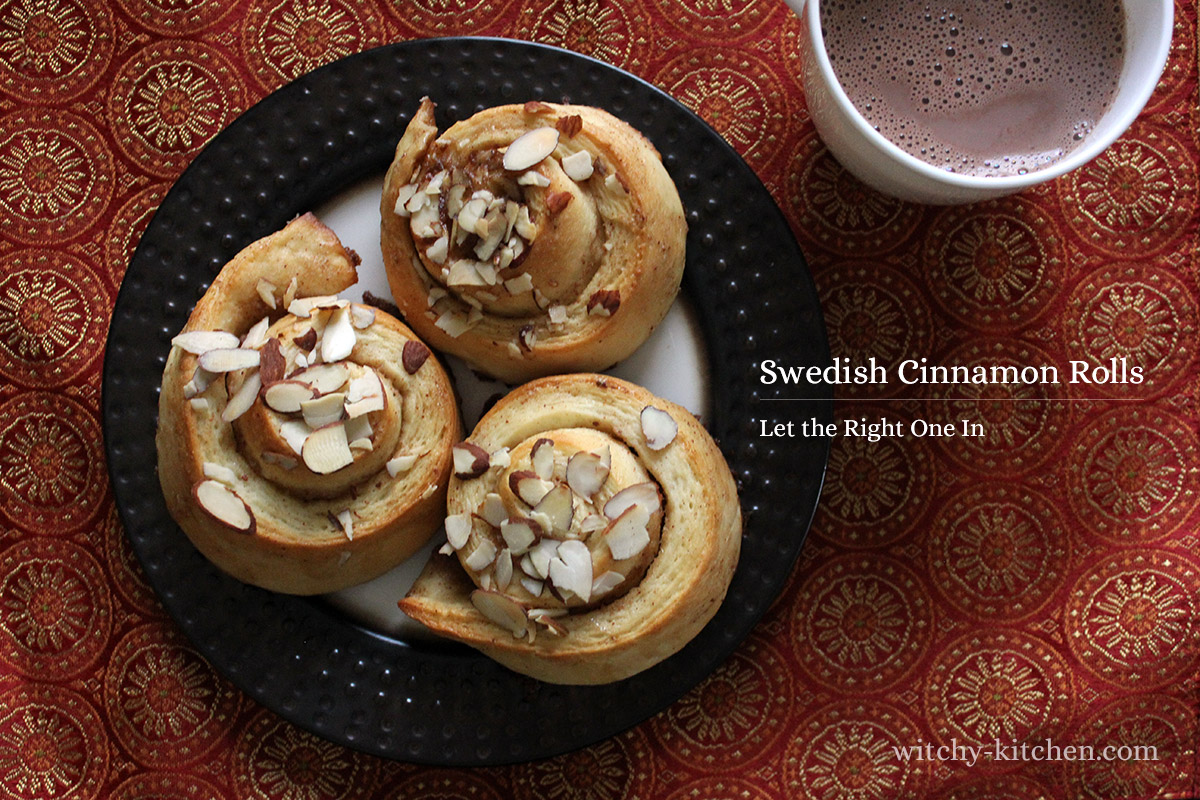
    Swedish cinnamon rolls aren’t much different than American style, the key enhancement being lovely, fragrant cardamom in the dough – a favorite spice of Scandinavians dating back to 860AD when the Vikings ravaged Constantinople! Heating milk with vanilla bean and cardamom on the stove made the kitchen smell heavenly.

    I adapted Marcus Samuelsson’s recipe — and when I say adapted, I mean I used whole cardamom instead of ground because that’s what I had, and I rolled them out to the wrong length and width because oops — but will actually make a few more tweaks when I make them again (which I will because they were delicious). The dough was actually a little stiffer than it was meant to be even though I added the least amount of flour, and the cinnamon mixture was way too thin and seeped out of the dough, so next time I’ll make it thicker. These kind of differences I usually chalk up to atmosphere or personal incompetence or whatever, so I’ll give you recommendations for humid American South, but you may also wish to check out the original recipe.

    Swedish Cinnamon Rolls

    Adapted from Marcus Samuelsson

    For the dough

    • 1 package yeast
    • 2 tablespoons warm water
    • 1 teaspoon sugar
    • 1 cup whole milk
    • 6 tablespoons butter
    • 10 cardamom pods, cracked
    • 1 vanilla pod, halved and scraped (substitute 2 teaspoons vanilla extract)
    • 1 egg plus 1 yolk (reserve extra egg white)
    • 1/3 cup sugar
    • 1/2 teaspoon salt
    • 3 1/2 – 5 cups flour
    • 2 tablespoons vegetable oil

    For the filling

    • 1/2 cup butter, softened
    • 1/2 cup brown sugar
    • 1/2 cup sugar
    • 2-4 tablespoons warm or hot milk (original calls for 4, mine was too watery)
    • 3 teaspoons cinnamon

    For the topping

    • Reserved egg white
    • 1/4 cup toasted almonds

    In a small bowl, mix yeast, warm water, and sugar. Set aside until foamy, about 5 minutes.

    Gently heat milk, butter, cardamom pods, and vanilla bean until very warm but not hot. Remove from heat and allow to steep until cool. Strain, and add to the yeast mixture. Whisk egg, egg yolk, sugar and salt until well combined, stir into yeast mixture.

    Add flour until a slightly wet dough forms, and roll it into a ball. Grease a clean bowl with the vegetable oil, and turn the dough ball in it until coated. Cover with plastic wrap and set aside for 2 hours.

    Combine the filling ingredients (butter, brown sugar, sugar, warm milk and cinnamon). Prepare two baking sheets with buttered parchment.

    Divide the dough into two equal parts, and on a floured counter roll into 12 x 9 inch rectangles. Spread with the filling mixture and roll length-wise. Slice into 6 slices and place on baking sheets, slightly flattening with your palm (next time I’ll tuck in the ends to make them a little prettier). Cover and let rise 30 minutes.

    Whisk together egg white with a couple tablespoons water and brush over the rolls. Sprinkle with toasted almonds. Bake at 350° for 15-20 minutes until golden brown. Cool on a rack.

    Serve in front of the TV with guilt and hot chocolate.

    Both The Girls in the Back Row and The Rants Macabre have a great podcast episodes on the film, I recommend a listen!