What’s your damage?Heathers, the 1989 black comedy written by Daniel Waters and directed by Michael Lehmann, is the liaison between 80’s materialism and 90’s nihilism. Winona Ryder is exquisite as Veronica, who’s wealthy and beautiful, yet dark and down to earth in a sea of Heathers led by Heather Chandler (Kim Walker). She practically defines the voice of the next generation.
Besides its cultural significance, there also happens to be LOTS of food in this quirky film. “Great pate, but I gotta motor,” Veronica quips after an afternoon with her parents. Pate is synonymous at this time with the wealthy, and seems significantly grown-up. The high school kids on the other hand, even the rich ones, prefer convenience store food – turbo dogs, Twizzlers and cherry Slushies! That’s charming, but the food references in the movie that age much less well are the flippant jokes about eating disorders, however significant in the story. Heather Duke (Shannen Doherty), timidly suffers bulimia under Heather Chandler’s rule, but after HC’s untimely demise she blossoms into the new queen whilst chowing on a drumstick.
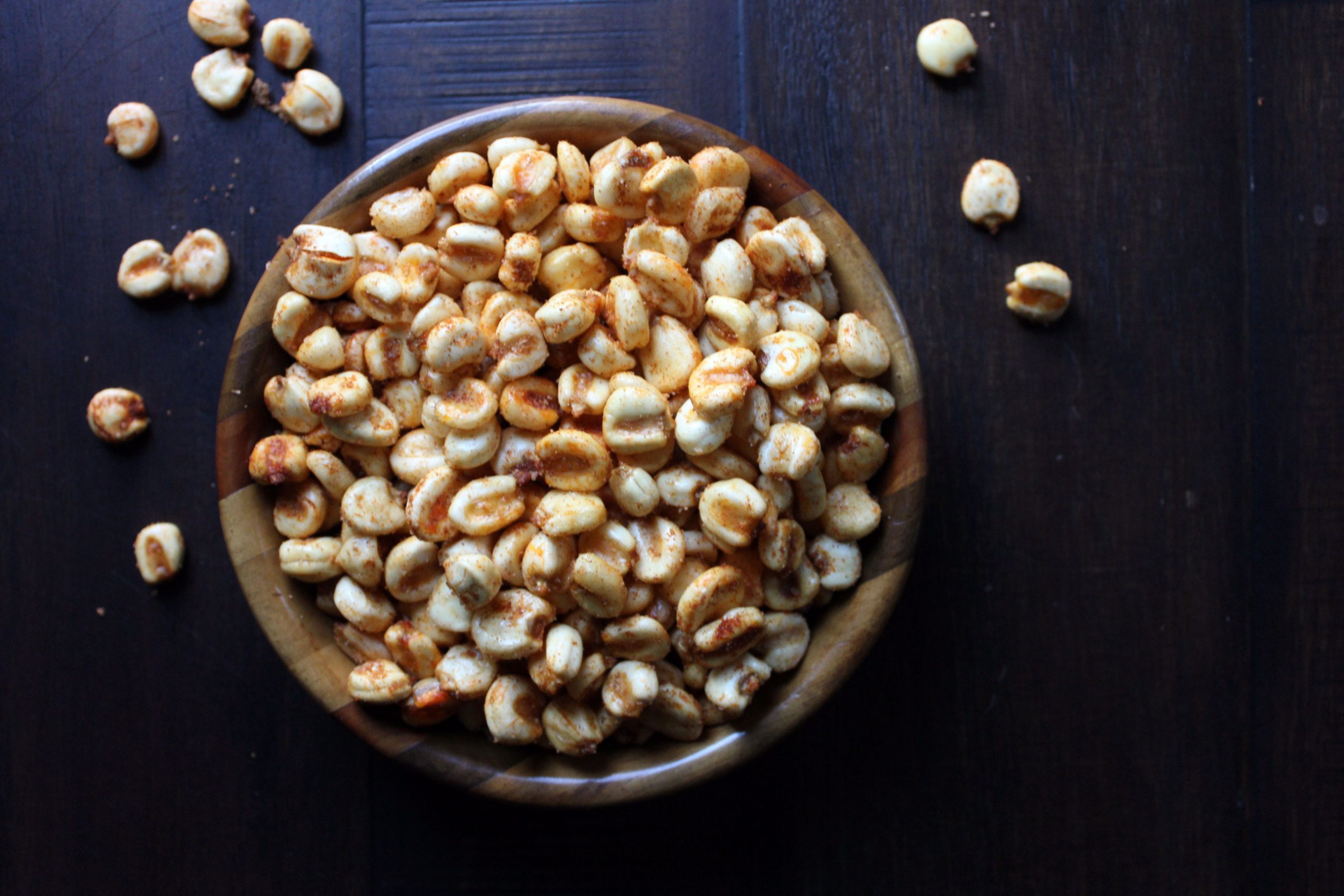
Pulled from some great options, what we’re making for Heathers are homemade BBQ corn nuts, that Veronica and Heather Chandler procure from the gas station. Delightfully both high brow (homemade!) and low brow (still corn nuts!), my main draw was that these crunchy little nuggets were queen bee HC’s dying words. (Sidenote, what would my dying words be? Probably crunchy tuna roll…)
Giant white corn kernels can be purchased in Hispanic groceries and perhaps even your grocery’s latin aisle. Soak them overnight to prepare. I tried one batch baked, and while I believe it’s possible, this is the less desirable option as your final product will be oilier, chalkier, and with a higher chance of burning your spices. I don’t deep fry often, but I find several inches in my smallest sauce pan isn’t too much clean up, just fry in batches and you’re golden, literally. The BBQ spice mix is super simple and can be used on meats, veggies, and whatever you choose, but today…it’s corn nuts.
BBQ Corn Nuts
1 pound giant white corn kernels (soaked at least 8 hours, preferably overnight)
vegetable oil for frying
1 tablespoon sea salt
2 teaspoons brown sugar
1/2 teaspoon smoked paprika
1/2 teaspoon cumin
1/2 teaspoon garlic powder
Drain and towel dry corn kernels. On medium high heat, heat 3 inches or so of oil. Fry the kernels in single-layer batches for 9-12 minutes, turning gently every few minutes, until golden and slightly puffed. Remove with a slotted spoon to a large paper towel-lined dish.
While the first batch of kernels are frying, combine the sea salt, brown sugar, paprika, cumin, and garlic powder in a small bowl with a fork. With each drained batch, sprinkle generously with the spice mix, and once the batch is cool enough to handle, toss to coat.
Serve with drinks – preferably beer, less preferably drain cleaner.
Edgar Allan Poe, an author synonymous with American gothic horror writing, and Vincent Price, an American horror actor with a velvet voice and looming stage presence, are a match made in hell. Working with filmmaker Roger Corman, Price starred in a number of Poe pieces adapted for the silver screen, and brought macabre classics such as House of Usher (1960), The Pit and the Pendulum (1961), and The Raven (1963) to life.
Price wasn’t just an actor though; a true Renaissance man, he was an accomplished art collector and museum founder, as well as a fantastic cook and co-author of several cookbooks with his wife Mary Price. A Treasury of Great Recipes (1965) is probably the most well-known, but Mary and Vincent Price’s Come into the Kitchen Cook Book (1969) seemed like a good place to find a recipe worthy of Poe. It is organized by era with an enlightening historic intro to each, beginning in colonial America, spanning Antebellum years and westward expansion, and ending in “modern” recipes that are charmingly very 60s.
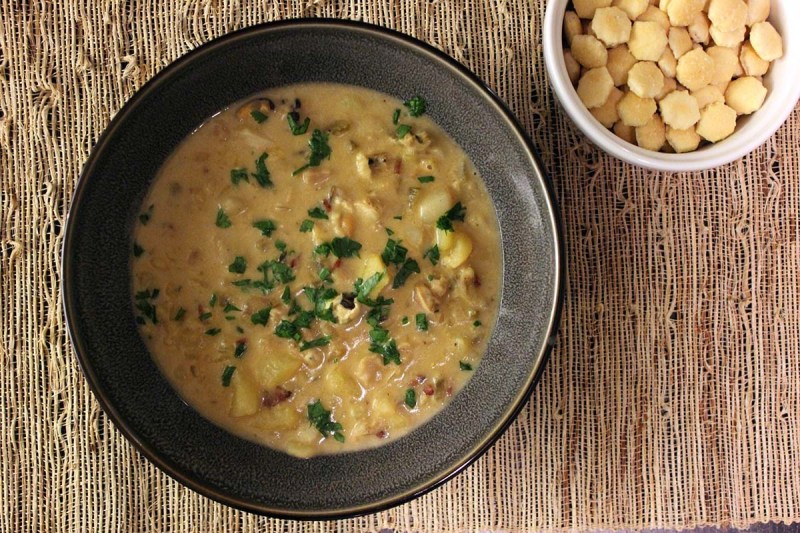
Poe was born January 19, 1809 in Boston, Massachusetts, so a classic regional recipe seemed like the perfect choice. For this New England Clam Chowder, I started with a combination of Price’s recipes for “Chowder” and “Stewed Cod,” and added potatoes to pad it out and celery to scandalize everyone in my house who claims they don’t like celery (but then gobbles up what I make with it anyway). Instead of the white wine that the recipes call for, I opted for sherry. But not just any sherry – amontillado – for that ominous Poe flourish.
New England Clam Chowder
1 pound clams, chopped, juice reserved
2 tablespoons butter
2 slices turkey bacon, chopped (if you use pork bacon, which is recommended but my kids don’t eat pork, you can omit butter)
1 onion, diced
2 stalks celery, diced
1 teaspoon salt
1/2 teaspoon white pepper
2 tablespoons flour
1/4 cup dry sherry (preferably amontillado) + 2 tablespoons to finish
3 cups vegetable broth
1 pound potatoes, peeled and diced
1/2 teaspoon thyme, roughly chopped
2 bay leaves
1/2 cup heavy cream
juice of half a lemon
chopped parsley, oyster crackers, and hot sauce for garnish
In a pot, heat butter on medium heat and cook bacon until brown and crispy. Add onion, celery, salt and white pepper and cook, stirring, until onion begins turning golden. Lower heat and add flour, and cook, stirring, for several minutes.
Turn heat up to high and add sherry, cooking and stirring until almost dry, then add vegetable broth, potatoes, thyme, bay leaves, and reserved clam juice. Bring to a boil then lower to a simmer and cook, uncovered, stirring occasionally, for 15-20 minutes until potatoes are very tender and able to be easily smashed against the side of the pot with a spoon. Smash a few but leave some for texture.
Stir in the heavy cream, lemon juice, and remaining 2 tablespoons sherry. Serve hot, with chopped parsley, oyster crackers and hot sauce.
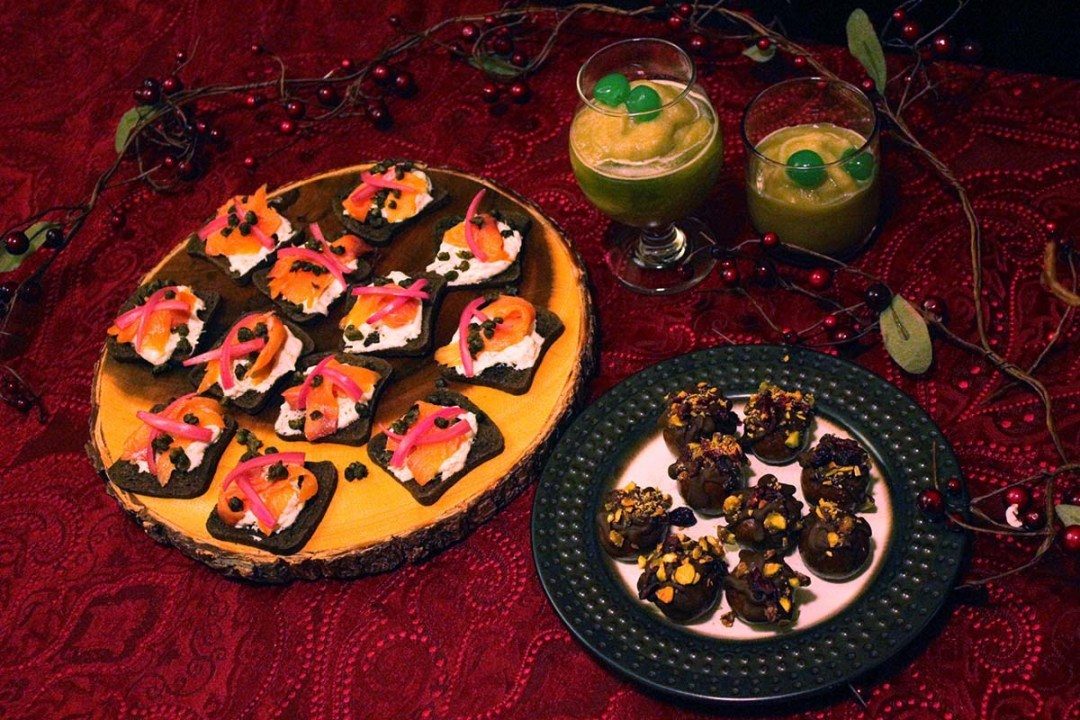
It’s the Christmas season, and our days are merry and bright…but our nights are cold and dark, and there’s enough Christmas horror that the holiday can almost be a second Halloween. If you like a little creepy in your Christmas, here’s a festive and simple cocktail menu inspired by seasonal horror films. These recipes are enough for a small gathering but can easily be doubled to share with all your fiends and family.
First up, drinks! I have a special place in my little black heart for 1984’s Gremlins, as it was the first horror movie I ever saw as a child. The Christmastime creature-feature gave me nightmares, and it was years before I realized that it is actually very funny and not the most terrifying movie ever made. That’s not to say it’s not terrifying; imagine being attacked by manic murderous cackling gremlins in your own kitchen. If you remember that scene, you’ll know why this is a green drink made in a blender! It’s green tea and bourbon sweetened by a Chinese five spice simple syrup that evokes the Chinatown antique shop that little mogwai Gizmo came from and bonus, it smells like Christmas. Just don’t serve your guests after midnight.
Spiced Gremlin (Cocktail)
2 cups strong green tea
1/2 cup sugar
1/2 cup water
1 teaspoon Chinese five spice powder
1/2 cup bourbon
green food coloring
green maraschino cherries for garnish
Freeze the green tea in ice cube trays. To make the simple syrup (you’ll end up with extra, but you can use it for other cocktails or tea), heat sugar and water in a small sauce pan on medium high, not stirring, until the sugar is completely melted. Remove from heat and stir in the Chinese five spice powder. Cool completely.
Combine green tea, 1/4 cup of the spiced simple syrup, bourbon, and several drops of green food coloring. Blend and serve, garnished with green maraschino cherries.
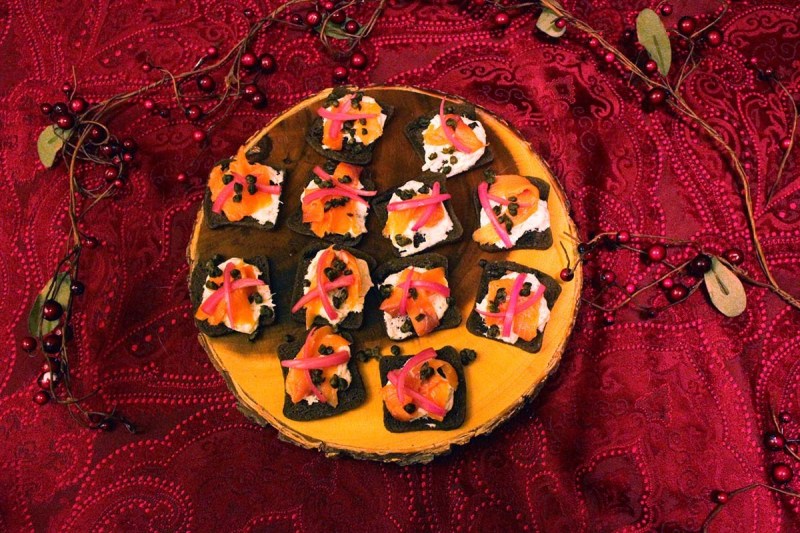
Next up is a savory snack. 2015’s Krampus is the story of a dysfunctional family holiday gathering turned dark by the demon from European folklore, and though a fairly recent film, is already a modern Christmas horror classic. There are some great food scenes, whether a tracking shot through the kitchen of the German grandmother’s copious Christmas baking, or the epic gingerbread battle. This appetizer comes from the dinner – every black humor family film needs a dinner scene – that the mom, Sarah (Toni Collette) has prepared. If you’re a fancy fussy host like Sarah and would take comments like “It looks like Martha Stewart threw up in here” as a compliment, but don’t have a week to cure gravlax, then these smoked salmon toasts with lemon dill sour cream, pickled red onion, and crispy capers are perfect. If you’re less fussy, just go with macaroni and cheese and hotdogs.
Krampus Smoked Salmon Toasts
1 small red onion, thinly sliced
red wine vinegar
12 ounces pumpernickel bread, the little party size or else sliced into 2 inch squares
1/2 cup sour cream
zest of one lemon
4 sprigs dill, finely chopped
1 tablespoon capers
olive oil
4 ounces smoked salmon, sliced
Combine red onion and enough red wine vinegar to cover and set aside for at least an hour. Heat the oven to 350° and place bread slices in a single layer on baking sheets. Brush with olive oil and bake for 15 minutes until toasty. Cool. Stir together sour cream, lemon, and dill. In a small frying pan, heat a tablespoon or so of olive oil and fry capers until just turning golden, and drain on a paper towel.
Assemble the toasts: smear each square of pumpernickel with a spoonful of the sour cream mixture, top with a curled slice of smoked salmon, and garnish with a couple of slices of red onion and a sprinkle of crispy capers.
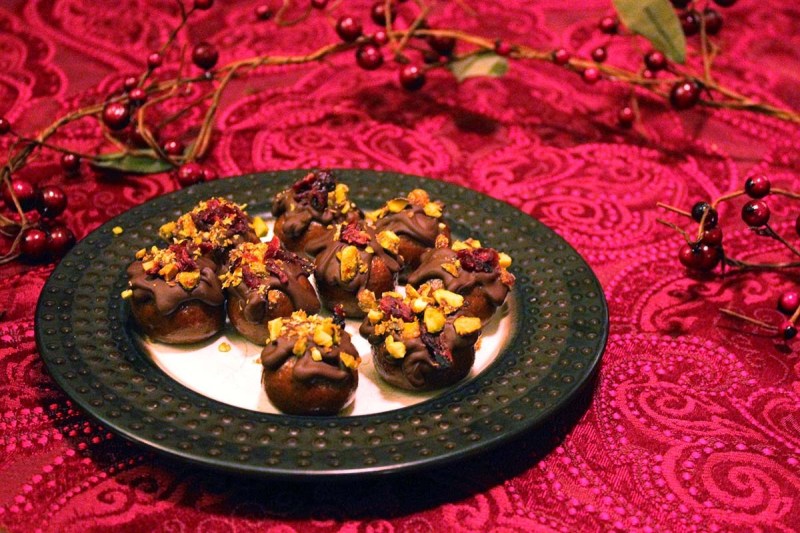
Finally we’re going sweeter, and a lot darker, with this treat inspired by the 1974 slasher Black Christmas. As one of the very first slasher films, it follows a deranged killer stalking a group of sorority girls, and is so creepy and unsettling that you’ll definitely need to stress-eat chocolate after viewing. So for that, we have these lovely truffles that are a bite-sized version of traditional English Christmas pudding. They are made from crumbled fruit cake, and are a little boozy, drizzled in dark chocolate and decorated with pretty green pistachios and dried cranberries.
Black Christmas Pudding Truffles
1 pound store-bought fruit cake
3 ounces dark chocolate chips, divided
2 tablespoons sherry, brandy, or rum
1 1/2 cups dark chocolate chips, divided
chopped pistachios and dried cranberries for garnish
Break the fruit cake into pieces into a food processor, and pulse a few times. Microwave 1/2 cup of the dark chocolate chips in 30 second increments, stirring in between, until completely melted. Add to the food processor along with the sherry, brandy, or rum, and combine, but don’t over mix.
On a parchment-lined baking sheet, roll heaping teaspoons of the fruit cake mixture into balls. The mixture will be very sticky, so to make this easier, every few balls coat your hands in a thin layer of vegetable oil, and don’t worry too much about the shape at this point as you’ll be able to correct it later. Put the baking sheet in the fridge for 30 minutes to set.
Once set, you can roll the balls again to get them rounder. Heat the remaining cup of dark chocolate chips in 30 second increments, stirring, until melted. Put the melted chocolate in a piping bag or ziploc with the corner cut off, and pipe over the balls. Garnish with pistachios and cranberries.
In the same way folklore transforms over time, 2018’s Suspiria is a thorough retelling of the classic 1977 Dario Argento Giallo horror. Though both films tell the twisted fairy tale of a beautiful, talented and determined American ballerina coming to an elite, witch-inhabited dance school in Germany, the space between the plot points is distorted and the tone completely shifted. The original is drenched in a vibrant, almost garish color palette and an intense, powerful Goblin soundtrack, while the reimagining directed by Luca Guadagnino is soft and de-saturated with the dreamy, droney sounds of Thom Yorke. More in the Nightmare on Filmstreet review.
Much like the films, this dish is heavily inspired by Snow White. Indeed our heroine, Susie Bannion (played in 1977 by Jessica Harper and in 2018 by Dakota Johnson), is a modern Snow White, who wanders into an enchanted world and has to fight attempts on her life from a jealous crone. As the Grimm brother’s Snow White tale comes from Germany and Suspiria takes place in Berlin, I definitely wanted the dish to have a German leaning, so chose a mixture of vegetables to roast with sausage.
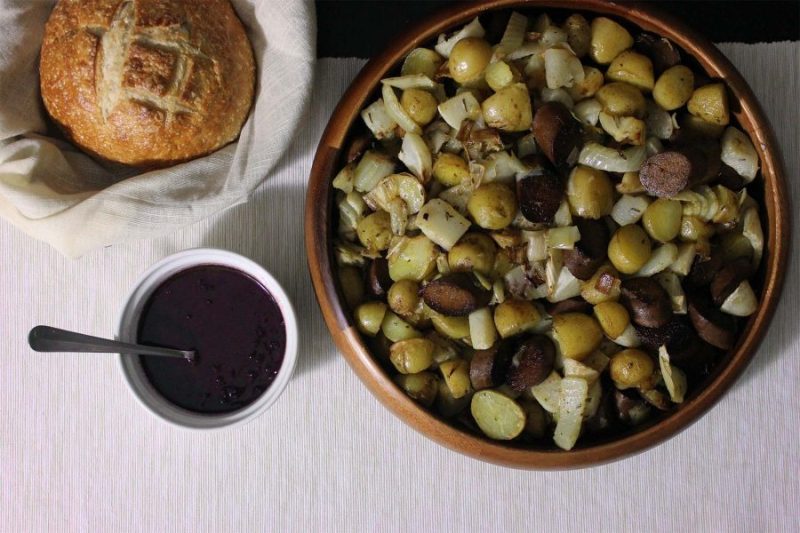
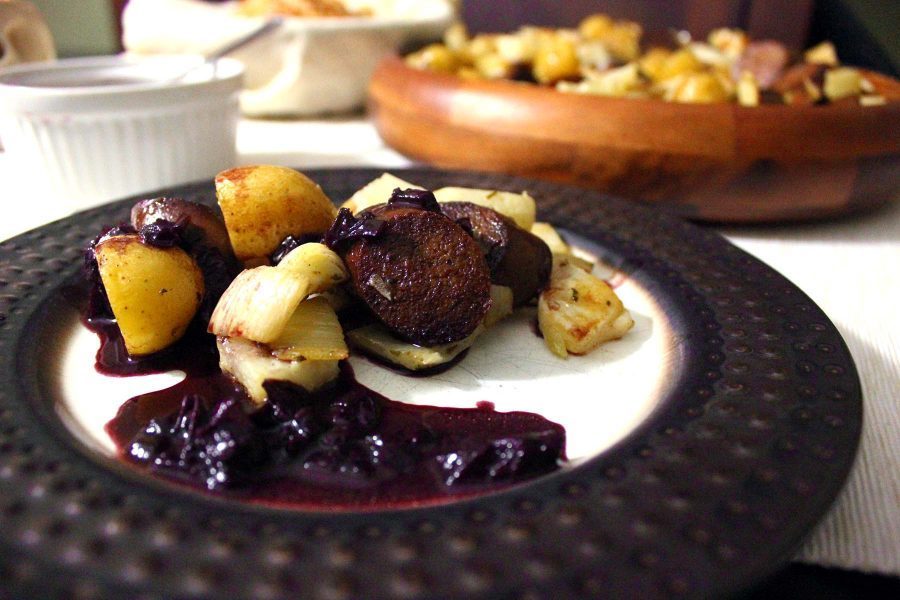
Color is so symbolic in both films, with the sweet ingenues often dressed in white, and red used in violent, jarring ways. The veggies used here are all white: darling little creamer potatoes, fennel, turnips and garlic. To accompany them I made a rich red wine reduction, also reminiscent of the wine Susie’s doctor gives her to drug her when she becomes too suspicious….it’s suspiciously delicious.
Snow White Roasted Vegetables and Sausage with Red Wine Reduction
For the veggies and sausage
1 1/2 pounds yellow creamer potatoes, halved or quartered
2 large bulbs fennel, trimmed and chopped into large chunks
2 medium turnips, peeled and chopped into large chunks
7 large cloves garlic, gently crushed and peeled
olive oil
2 sprigs rosemary, finely chopped
1 teaspoon coarse salt
1/2 teaspoon white pepper
1 pound peppery or sweet German or Eastern European-style sausage (we made this vegetarian by using Polish-style soy sausages), thickly sliced
Heat oven to 425°. Divide potatoes, fennel, turnips and garlic into two large baking dishes. Drizzle with a generous amount of olive oil, sprinkle with salt and white pepper, toss with your hands and spread into a single even layer. Bake for 20 minutes, then stir/flip, making sure to scrape up any brown bits on the bottom of the dish, spread evenly again and bake for 20 minutes more.
Meanwhile, heat a little olive oil in a pan and brown the sausage in batches, removing to a plate. After the first 40 minutes of roasting, reduce oven heat to 350° and divide sausage between the dishes. Bake for another 20 minutes. Check the veggies at this point; they should be very soft, some gently caramelized, and the potatoes and turnips not mushy but easily pierced with a fork. Bake another 10-20 minutes until they reach desired doneness. Transfer to a serving dish.
For red wine reduction
2 tablespoons butter, divided
1 medium shallot, finely chopped
1 cup vegetable broth
1 cup red wine
In a saucepan, heat 1 tablespoon of the butter and cook shallot until golden. Add vegetable broth and red wine and stir. Bring to a low simmer and cook, stirring occasionally, until the mixture has reduced to about a third of its volume. Remove from heat and stir in the remaining tablespoon butter.
To serve, spoon vegetables onto a plate and drizzle with the red wine reduction. Serve with warm, crusty bread.
‘Tis the season! We’ve decked the halls with cobwebs and pumpkins, and are so ready for the final confrontation between Laurie Strode and Michael Myers in 2018’s Halloween, directed by David Gordon Green.
John Carpenter’s original Halloween film (1978), is iconic. We get the fearsome, stalky villain that launched a thousand slashers, the original Scream Queen, goddess Jamie Lee Curtis, and the spooky synth soundtrack that became a genuine classic. The film is almost beyond reproach. Almost.
The one problem…it doesn’t feel like Halloween at all! The houses are barely decorated, and a few half-hearted trick-or-treaters do not a proper Halloween make. Most of the lack of seasonal feel comes from the fact that though it’s set in the Midwest in October, it was filmed in Southern California in May. The film crew struggled to find pumpkins, used artificial fall leaves on streets lined with fully green trees, and every once in a while you even get a glimpse of a palm.
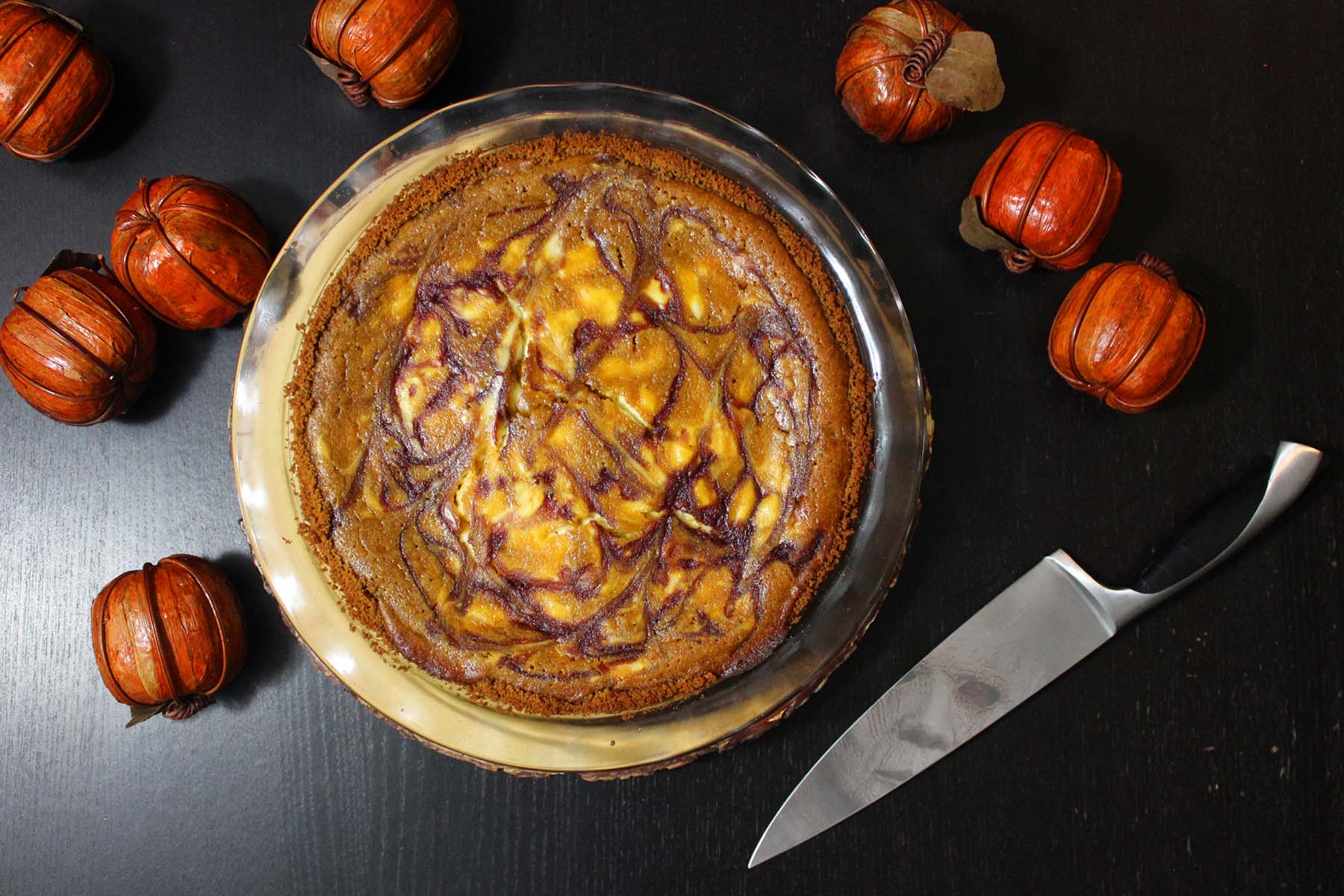
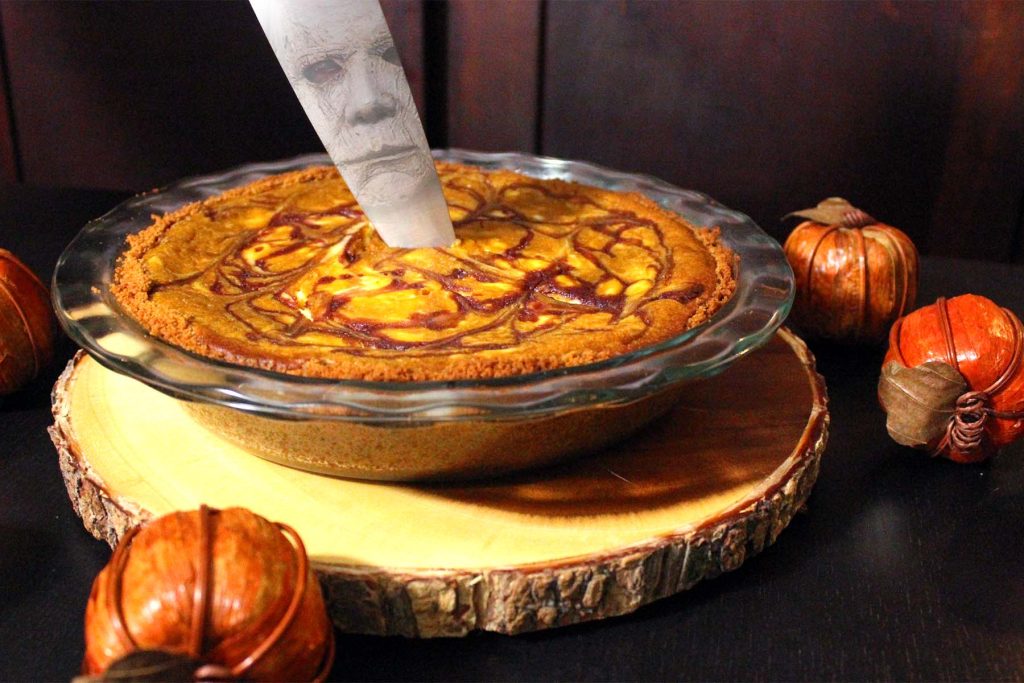
Here’s hoping the new film is every bit as scary and trope-y as the first, but pumped up with pumpkin spice! To honor the original, we’re making a pumpkin pie – the official pie of Illinois (which also happens to include our fictional town of Haddonfield) – marbled with California citrus. And not just any citrus: Myers, I mean Meyer, lemons. Meyer lemons are sweeter and less sharp than your basic lemons, but they aren’t quite in season – so if you have trouble finding them, using a mixture of lemon and orange works as well. The pie has a very snappy gingersnap crust, which is unfussy and compliments the filling well. There’s also a ribbon of pomegranate molasses flowing through, a quite autumnal ingredient with a gorgeous color that I never miss a chance to use. It works particularly well here to evoke blood. Slice with a BIG SHARP KNIFE and serve!
Myers Lemon Pumpkin Pie
For the crust
9 ounces gingersnap cookies
3 tablespoons butter, melted
Heat oven to 350°. In a food processor, blitz the cookies to crumbs, then add melted butter and pulse several times to combine. Press into a greased 9 inch glass pie plate, using the heel of your hand to flatten and gently spread it up the sides of the plate, and toast in the oven for 10 minutes until golden. Cool slightly before filling.
For the pumpkin mixture
1 15 ounce can pumpkin puree
1/2 teaspoon cinnamon
1/2 teaspoon nutmeg
1 teaspoon salt
1/2 stick butter, melted
3 eggs, beaten
2 teaspoons vanilla
1/2 cup heavy cream
1/4 cup flour
Using a hand mixer or whisk, blend together pumpkin puree, cinnamon, nutmeg, salt, butter, eggs, vanilla, and heavy cream. Sift flour into the mixture and blend until combined.
For the citrus cream cheese
6 ounces cream cheese, softened
2 teaspoons Meyer lemon zest (or a combination of lemon and orange zest)
2 teaspoons Meyer lemon juice (or a combination of lemon and orange juice)
1/4 cup sugar
3 tablespoons heavy cream
Using a hand mixture, blend all ingredients.
To assemble
2 tablespoons pomegranate molasses (you can purchase this at a Middle Eastern grocer, or make it yourself by boiling down pomegranate juice to about a third of its volume and cooling)
Pour pumpkin mixture into pie crust. Spoon cream cheese mixture over top and use a knife to marble it into the mixture. Drizzle pomegranate molasses on top and give it a last swirl with the knife before putting in the oven, at 350° for 50 minutes until just set.
Allow to cool at least 3 hours and even better, overnight, before serving.
The latest installment in James Wan’s The Conjuring Universe has arrived. The Nun, directed by Corin Hardy (The Hallow), starring Demián Bichir (Alien: Covenant) and Taissa Farmiga (American Horror Story, The Final Girls), is a departure from the usual haunted houses of the franchise and takes us to a Romanian monastery inhabited by a terrifying demon nun. Two nuns up, or a bunch of nunsense? You can read the Nightmare on Film Street Review here.
No matter your feelings on the movie, the setting is beautiful. From the castle-like abbey to the creepy crypts and underground tunnels, the Romanian architecture and religious iconography create a gorgeously gothic atmosphere.
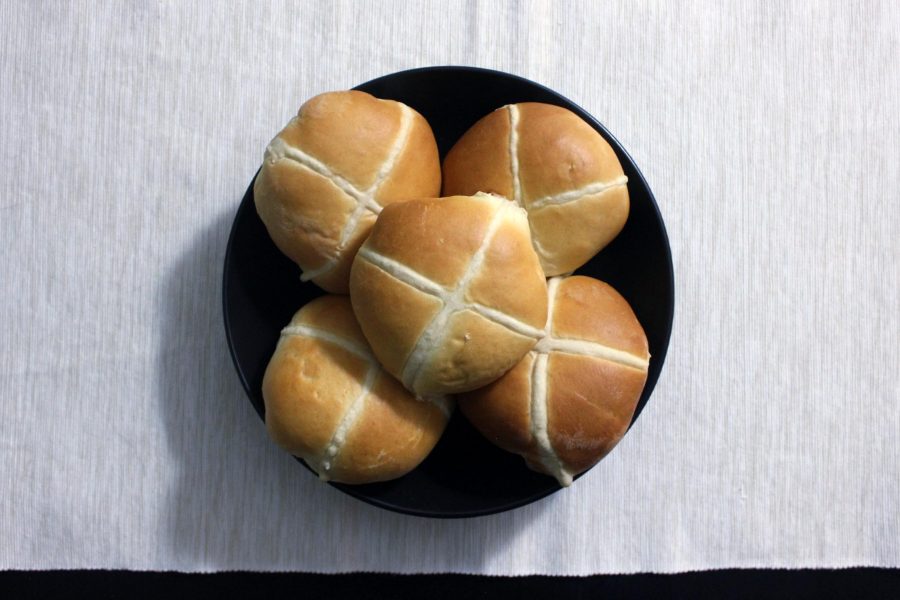
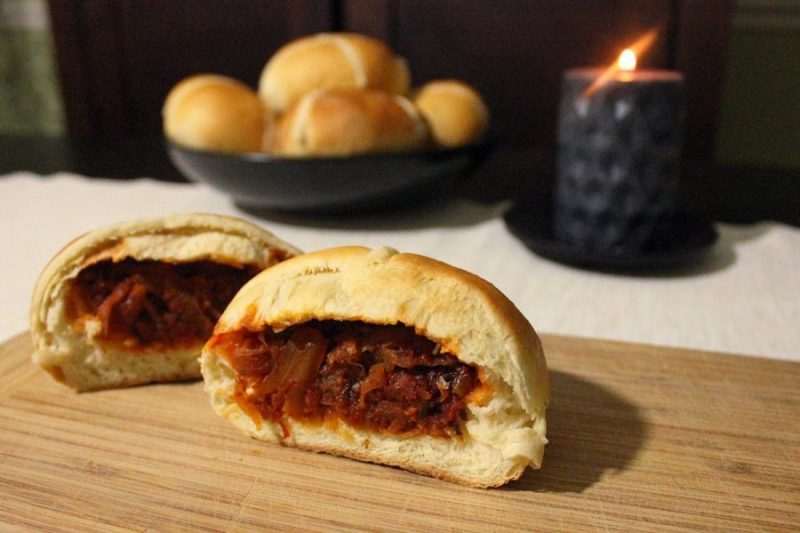
This Nun-inspired recipe draws on both Romanian cuisine and religious symbols. The filling is a pumped-up version of a Romanian stewed cabbage dish called varza calita, flavored with garlic, white wine, tomato, herbs, and delicious smoked paprika, which sinfully makes all vegetarian food taste like ham. The buns are similar to German bierocks, but crossed like hot cross buns to evoke our wicked demon nun. The combination of bread and a filling splashed with wine makes these the body and blood of Christ rolled into one – and a recipe every bit as blasphemous as the film. Enjoy!
Cabbage-Stuffed Hot Cross Buns
For the dough
1 cup milk
2 tablespoons melted butter
3 tablespoons sugar
1 1/2 ounce package yeast
1 egg, lightly beaten
1/2 teaspoon salt
3 1/2 – 4 cups flour
Lightly warm the milk (not so hot as to kill the yeast), and in a mixing bowl, mix well with butter and sugar. Mix in the yeast and allow to sit for 10 minutes until foamy. Stir in the egg and salt, and 3 cups of the flour. When it pulls together in a shaggy ball, dump on a well-floured surface and knead for about 10 minutes, adding flour a little at a time when it becomes too sticky to handle (another ½ cup to 1 cup). You are aiming for a slightly tacky, very elastic dough. Roll into a ball and place in a greased bowl covered with a damp dishcloth to rise for about an hour.
For the filling
3 tablespoons butter
1 onion, diced
3 cloves garlic, grated
1 tablespoon smoked paprika
1/4 cup white wine
1 14 ounce can diced tomatoes
1/2 – 1 teaspoon salt
2 bay leaves
1/2 pound sauerkraut
1 tablespoon finely chopped dill
1 tablespoon finely chopped parsley
Heat butter on medium heat and cook onion until deeply golden. Add garlic and paprika and stir until fragrant, and splash in the wine. Cook until dry, then add tomatoes, salt and bay leaves, and cook, stirring often, until tomatoes are completely broken down and jammy. Add sauerkraut (you don’t need to drain, but pull out with your hands so you don’t take too much of the liquid) and cook until mixture is thick and mostly dry. Remove from heat, stir in dill and parsley, and adjust seasoning if necessary. (Since this is a filling, you want it a little drier and saltier than if it were a side dish).
For assembly
1 tablespoon milk
3-4 tablespoons flour
Punch down the dough and divide into 8 equal balls. One at a time, roll out to about 6 inches in diameter and put a couple spoonfuls of the cabbage mixture in the center. Gather the dough around the mixture and pinch together well to seal, then gently roll the whole ball in your hands to shape. Place sealed side-down on a greased baking sheet and continue with remaining buns.
Allow to rise for 30 minutes. 20 minutes into the rising time, heat the oven to 375°. Brush the balls with milk. For the crosses, whisk together flour with enough water to make a consistency thick enough to hold its shape but thin enough to be piped. Scrape into a piping bag and pipe crosses.
Bake for 20-25 minutes until golden brown. Cool slightly and serve.
The Slender Man mythology, originating from a creepypasta story on the Something Awful forums sometime in 2009, has wound its way through our society, from spooky Internet meme to real life crime. Most recently, the character appears in the film Slender Man, directed by Sylvain White (who has directed episodes of The Americans and Sleepy Hollow). It was written by David Burke, and staring Joey King (The Conjuring), Julia Goldani Telles, Jaz Sinclair, Annalise Basso and Javier Botet as the titular character.
Though the film itself may feel disappointingly thin (you can read the Nightmare on Filmstreet review here), the folklore itself is fascinating and it’s not hard to see how this spooky tale went viral. Slender Man is a supernatural figure, unnaturally tall with long, Lovecraftian tentacle-like arms, who wears a suit, and has a stark face without features. He dwells in the dark woods , and snatches children in the night. An insidious monster, he’s shadowy, has unknown motivations, and preys on the most innocent people in our society.
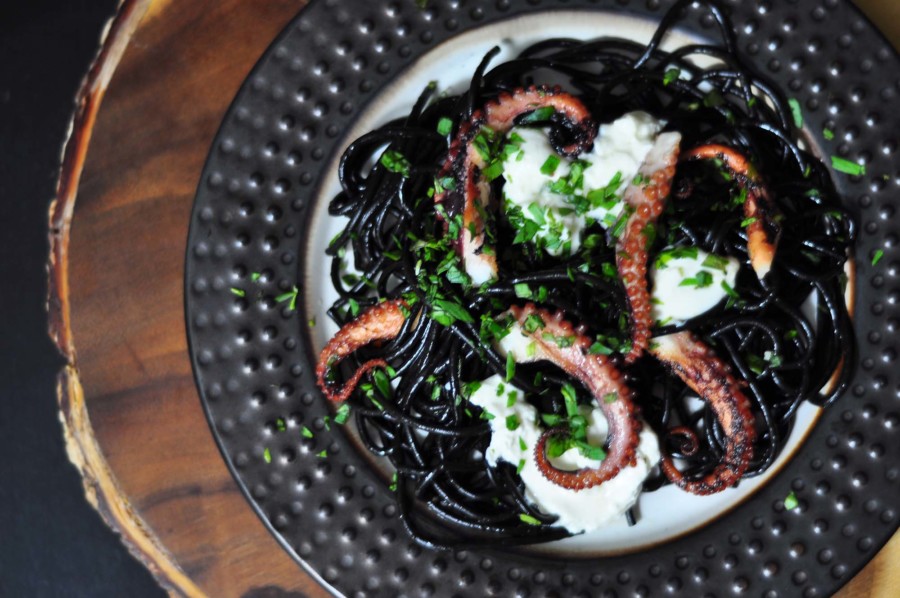
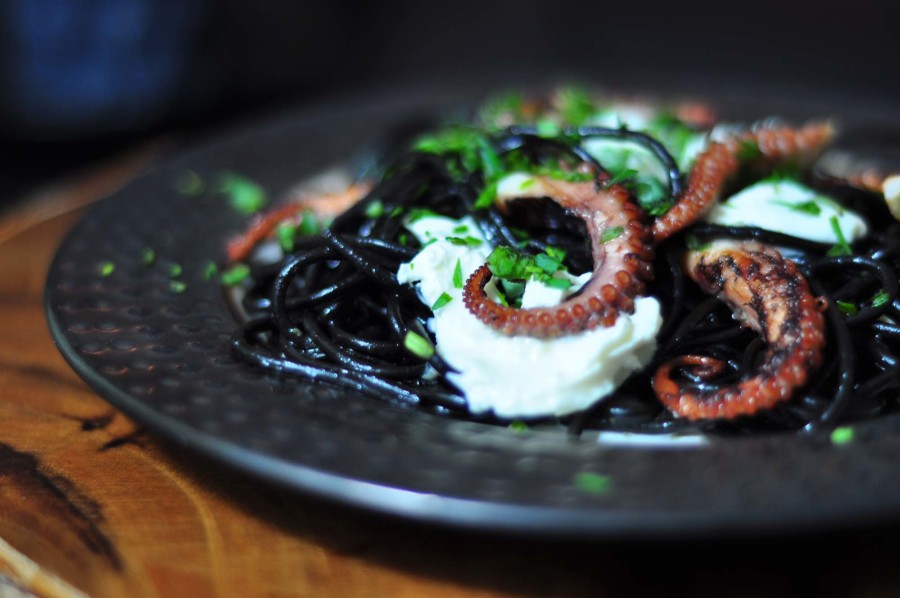
So what are we cooking up inspired by the most famous advent of Internet folklore, Slender Man? An elegant and very literal Creepy Pasta! Squid ink is what makes this spaghetti inky and black; the aesthetic is perfect, and it’s tasteless so you can cook it the same as any other spaghetti. Burrata cheese is pale and striking like Slender Man’s featureless visage. It’s lovely and creamy in this dish (if you can’t find burrata, fresh mozzarella would work as well), and the tarragon that seasons it is fragrant greenery that could be foraged in his woodsy home. The ingredients marry together like an evil plan.
If ink black pasta isn’t enough, it’s the octopus tentacles that take this dish into full creepypasta territory. They look impressive, and may seem daunting, but octopus is actually not too difficult to cook. It just takes a little patience stalking – I mean watching over – your cooking pot. Octopus can be rubbery, but slowly simmering it in a flavorful liquid for a long time yields tender tendrils that you can coil over your final dish.
Creepy Pasta (Squid Ink Pasta with Octopus and Burrata)
For the octopus
1 pound octopus, cleaned and rinsed
3 tablespoons olive oil, divided
1 lemon, quartered
3 garlic cloves, smashed
In a large pot, heat 2 tablespoons olive oil and place the lemon slices, skin down, for several minutes until charred. Charring the lemon will give a stronger lemony flavor. Add garlic cloves and stir until fragrant, being careful not to burn. Add several cups of water and bring to a low simmer on medium low heat. Gently lower octopus into the pot, and if necessary add enough water to cover. Simmer the octopus until very tender, about hour and a half, checking occasionally for water level.
Drain and gently remove octopus and pat dry. Cut tentacles off the head (which you can discard). In a small pan, heat 1 tablespoon olive oil and sear tentacles on both sides until lightly golden. Remove and set aside.
For the pasta
4 ounces squid ink pasta
3 tablespoons olive oil
3 garlic cloves, sliced
1/4 cup white wine
juice of half a lemon
salt to taste
1 4 ounce ball burrata, torn
small handful tarragon, finely chopped
Cook pasta al dente in well-salted water according to package directions. Before draining, reserve a half cup or so of the pasta water.
In a large pan, heat olive oil and saute garlic until lightly golden. Add white wine, lemon juice, and a pinch of salt, and cook until liquid is reduced and mostly cooked off. Add pasta to the pan and toss to coat, adding pasta water a tablespoonful at a time until desired consistency (liquid should just coat pasta but not be soupy).
Serve on a large plate; arrange torn burrata and octopus tentacles on top, drizzle with olive oil, and sprinkle with chopped tarragon. Serve hot!
2018 supernatural horror film Hereditary, directed by Ari Aster and featuring Toni Collette, Milly Shapiro and Alex Wolfe, began by lulling me into the typical horror formula (I’ve seen a few ghost movies, ok?) and then took a gut-wrenching turn that shocked me to tears and left my body a twisted lump of tension for the rest of the film. The haunting performances, droning soundscape, unsettling dollhouse motif, and masterful building of absolute dread, all wrapped up in an uncomfortable family drama, is far and away the most horrific thing I’ve seen this year.
Very light spoilers ahead…this recipe is tied into the plot of course but I won’t say too much…
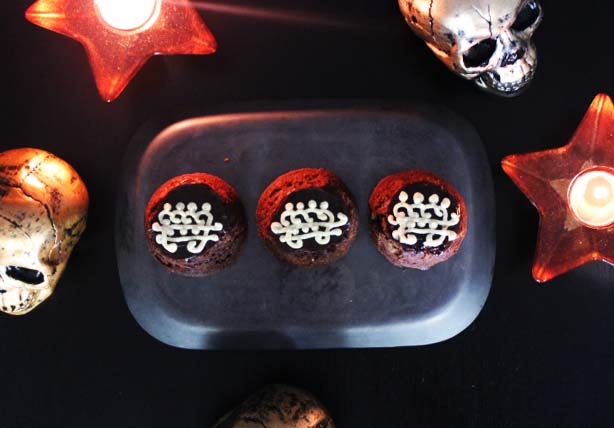
For most of this ghastly torture of a movie I was thinking there was no way I could do something as frivolous as a recipe, but then the third act turns so wacky and has an such an interesting thread of mythology that I was back in. The 13-year-old daughter Charlie, has a love of chocolate and a well-established nut allergy, so of course I wanted to include those in my recipe. It was the demon king Paimon though that inspired me to make these as altar cakes, smeared with ganache, a dark offering to his hellish excellency. His intricate sigil appears over and over in the film, so these are so marked with walnut buttercream. Hail Paimon! (Please accept these and stay away).
Melt the chocolate chips and butter together in the microwave, stir until smooth and allow to cool. Meanwhile, beat together sugar and eggs and stir in vanilla and the chocolate mixture. Mix in flour until just combined and stir in walnuts.
Pour into lined muffin cups and bake for 20-25 minutes until a toothpick comes out clean. Cool, remove from liners, trim the tops flat if necessary and flip upside down to decorate.
For the ganache
1/2 cup heavy cream
1 cup semisweet chocolate chips
Bring heavy cream to a boil and pour over chocolate chips, stir until smooth. Cool to room temp. Smear over tops of the cakes.
For the walnut buttercream
1 cup powdered sugar
1/2 stick softened butter
1 ounce walnuts
1+ teaspoon milk
Combine well all ingredients in a food processor. Transfer to a piping bag and scribble hell king sigils on your altar cakes. Offer and wait.
Recipe for Fiction Kitchen Episode 60: VOLTRON & HEREDITARY in which Diana and Carrie discuss discuss robots in space and terrifying family dramas! Food goo, garlic knots, cake roll pops, Checkov’s walnut allergy and uncomfortable family dinners.
This month’s theme is #FOODOFTHEGODS – dishes inspired by mythology – hosted by me, Carrie @ Witchy Kitchen. Check the hashtag or the Link up for all sorts of mythic meals.
I’ll give you a strawberry if you keep this a secret.
I’ve had a murderously good time watching Death Note, an anime about a mysterious notebook bestowed on the sociopathic high-schooler Light by a terrifying puppy of a shinigami (Japanese god of death), Ryuk. Writing someone’s name will kill them, and when Light starts killing criminals left and right, with the goal of some weird utopia he can reign over, the brilliant and feral detective “L” is on the case. The series hurls forward, with maximum escalation and zero filler, and twists and turns somehow happen exactly as planned.
The dark series is balanced by hilarious scenes – one of my favorites is Light, knowing he is being surveilled by L, concocting a plan to continue his nightly killing spree after homework and before bed. He hides a small TV inside a bag of chips to be able to gather his victims’ names from the news while it looks like he’s doing school work. As he explains his diabolical plan to dramatically swelling music, he declares “I’ll take a potato chip…and eat it!”
As Diana pointed out on our podcast, Fiction Kitchen, this 3 ingredient recipe represents all three main characters; Light chomping chips as he murders criminals with the stroke of a pen, Ryuk the shinigami who adorably devours apples, and L, who holes up in a hotel room or office building with massive amounts of sweets to fuel his surveillance, theory forming, and game of cat and mouse.
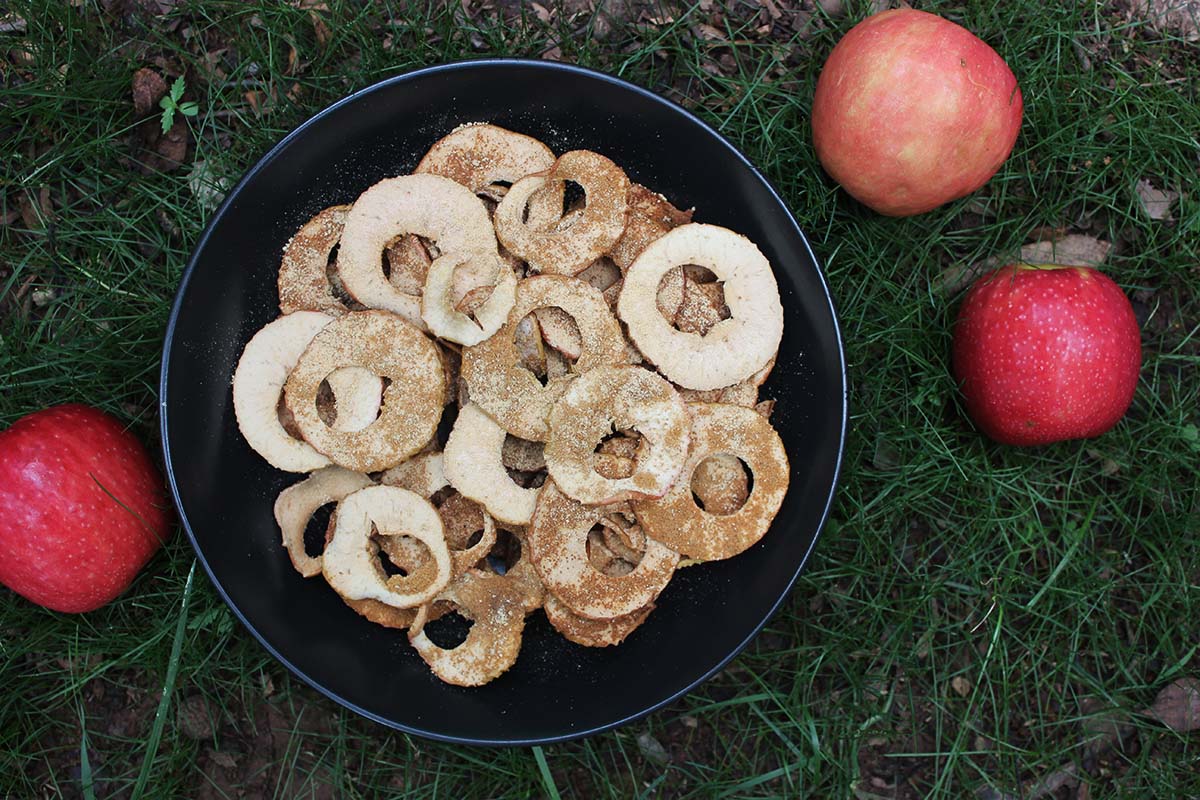
For my recipe I wanted to make apple chips a little special by using a distinctly Japanese ingredient; kinako is roasted soybean flour, and is often used to dust sweets such as dango. It has a deliciously toasty nutty flavor, and some fat which adds a richness to the apples. A match made in heaven (or death realm, whichever).
`
Kinako Apple Chips
3 smallish apples, cored and thinly sliced
1 1/2 tablespoons brown sugar
1 1/2 tablespoons kinako (roasted soybean flour)
Heat oven to 200° and line two baking sheets with parchment paper.
In a bowl, blend brown sugar and kinako with a fork. Arrange apple slices in a single layer and sprinkle liberally with the brown sugar/kinako mixture, reserving about a teaspoon. Bake for about 2 hours, rotating halfway through, checking near the end to make sure the apple slices don’t burn.
Cool for a few minutes on the pan and remove with a spatula, serving sprinkled with a little of the reserved brown sugar/kinako mixture.
Recipe for Fiction Kitchen Episode 58: DELICIOUS IN DUNGEON & DEATH NOTE in which Carrie and Diana discuss the food manga Delicious in Dungeon & anime “Death Note”. There will be golem veggies, ghost ice cream, temptation apples, traditional Japanese sweets, and more!
Wouldst thou like the taste of butter? A pretty dress? Wouldst thou like to live deliciously?
It’s #Witchtober, hosted by Fiction Food Café. Check the tag on social media for wickedly witchy recipes!
The Witch (2015), a “New-England Folktale” written and directed by Robert Eggers, is haunting, unsettling, and painstakingly historically accurate. From the dialog to the clothing to the Puritanical hysteria, the colonial ambience is on point. I’ve read several times how it’s not very scary, however (light spoilers) with actual baby-smashing witches, creepy twins, writhing possession and a goat which is terrifying even in its most mundane state – I respectfully ask what more do you want?
The family dynamic in this movie is refreshing. It could have easily been a story about religious authoritarian parents repressing their daughter who is on the cusp of womanhood. Instead, though devout, they are a family who truly cares about one other and are trying their best both to live righteously and survive in a harsh new land. The parents are both Game of Thrones alums, Ralph Ineson of the low booming voice, and Kate Dickie who has the market cornered on disturbing breastfeeding scenes. Anya Taylor-Joy as Thomasin, the oldest daughter, is fresh and earnest in the face of unknown evil. Bonus points to Black Phillip for exceptional goat acting.
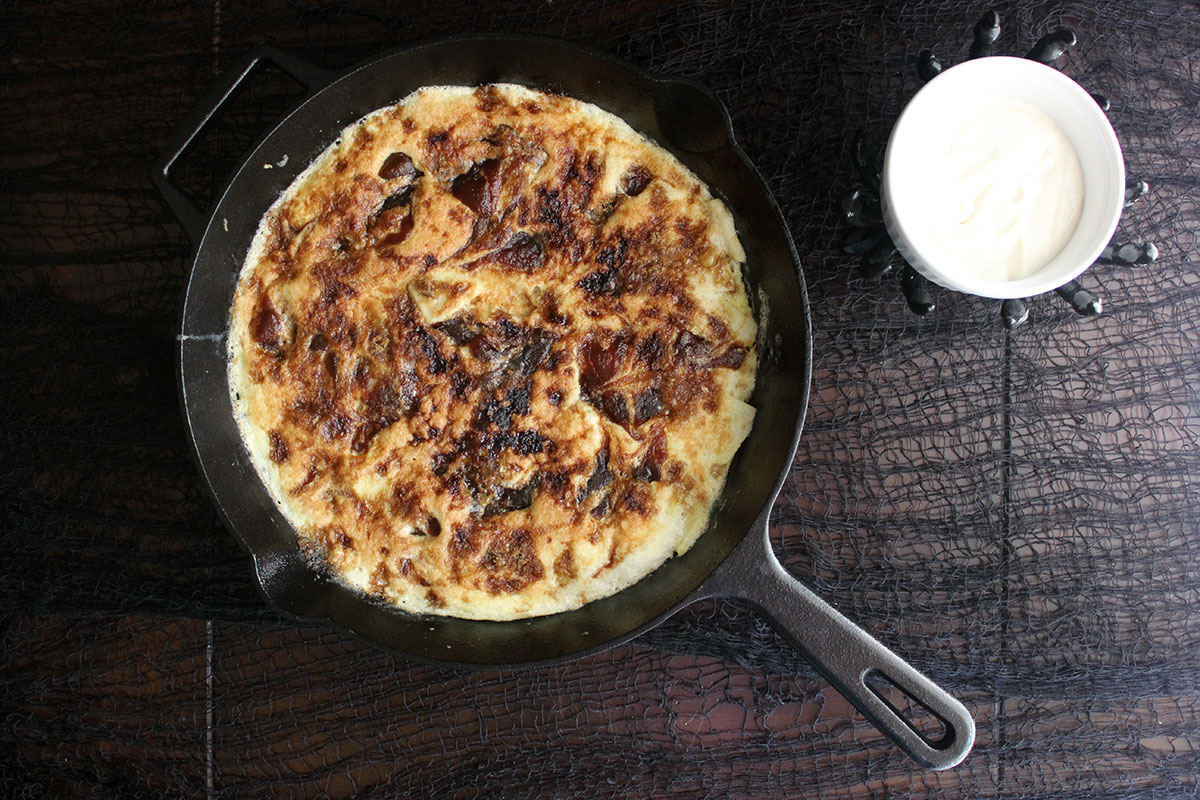
I made a classic colonial dish, Apple Tansey, based of a recipe that can be found in The Compleat Housewife, first published in London in 1727 and the first cookbook to be published in the United States. A tansey is basically an egg-based dessert, and this one contains apples (and apple butter) which the children in the movie reminisce about eating back in England. The apples are cooked in plenty of butter of course, the luxury so unctuously uttered into Thomasin’s ear, and served with a lightly sweetened goat cheese cream to honor our king of sky and land, sea and sand, Black Phillilp. Wouldst thou like to live deliciously? Read onward.
Apple Tansey with Goat Cheese Cream
For the tansey
2 Granny Smith apples, peeled, cored, halved and sliced
Heat the broiler. On the stovetop in a cast iron skillet or other deep oven-proof pan, melt butter, and cook apple slices on medium until softened (7-10 minutes). Meanwhile, whisk egg yolks with sour cream and sugar, whip egg whites until white and frothy and fold into the egg mixture. Lower heat to medium low and stir egg mixture into apples with a spatula and smooth on top. Swirl in the apple butter and cook for 4-5 minutes until set. Sprinkle with brown sugar and place under the broiler until brown and bubble. Cool slightly before serving with goat cheese cream.
For the goat cheese cream
4 ounces goat cheese, room temperature
1/4 cup heavy cream
1 tablespoon sugar
Whip goat cheese until smooth. Separately, whip cream to soft peaks, then blend with goat cheese and sugar until smooth. Serve with the tansey.