I like typically well regarded films. I gravitate toward arthouse films, heavy with plot and symbolism, featuring nuanced, often heartbreaking performances. I appreciate artistic vision, thoughtful scores, clever screenwriting. High scoring films on Rotten Tomatoes! I like good movies.
I also LOVE late 90s/early 2000s teen horror! It’s not that these movies aren’t good or lack the aforementioned qualities. I’ll argue they’re great, the iconic Scream especially, just that they’re not exactly regarded as high art or as “transcending genre” as some (not me) like to say. If you believe in guilty pleasures (yes me. Somehow the concept just makes it feel more fun), you can safely call these guilty pleasures.
The Faculty, Urban Legend, Disturbing Behavior – at the risk of dating myself, I was the perfect age for these movies when they came out and saw a lot of them in the theater, munching nervously on popcorn and gasping at jump scares with my school friends. I’ll admit that a lot of my affinity is rooted in nostalgia. But with entertaining storylines, beautiful actors in glorious 90s fashion, and slick references to horror classics, these movies are genuinely, unironically valuable, not to mention very fun.
I Know What You Did Last Summer, the 1997 slasher written by Kevin Williamson and directed by Jim Gillespie, is quintessential teen horror. It features a collection of actors who seem like they were in every late 90s movie (Jennifer Love Hewitt, Sarah Michelle Gellar, Ryan Phillipe, Freddie Prinze Jr.), and a distinctive villain characterized by his fisherman’s jacket and hook.
It was filmed largely in the quaint beach town of Southport, North Carolina, and as I spent my summers as a kid on the Carolina coast, this was another draw for me. The small town is atmospheric, and is instrumental in demonstrating how everyone’s lives fell apart after the inciting incident. It’s tragic when Helen escapes to New York to be an actress and then has to return somewhat humiliated when “it didn’t work out.” It’s tragic when Ray becomes a fisherman and it’s implied that he’ll never leave and that’s all he’ll ever be. Southport, which seemed charming at the beginning of the film, when the friends were happy and carefree, becomes a symbol of their guilt and failure.
I’m definitely on a regional seafood kick this summer (see last month’s Jaws-inspired Amity Island Shrimp Boats), so for a recipe, I immediately thought of Fisherman’s Stew. The North Carolina version of this dish is one of those that is traditionally made in a huge pot for a crowd, a la Frogmore Stew or other seafood boils, though this particular recipe is family-sized. Bacon is crisped up to later be crumbled on top, then a tomatoey mixture is cooked to season the broth. Then, potatoes, onions and garlic, and a firm fish (like red drum, sheepshead, cod, or even snapper like Julie’s mom makes for her when she returns home) are layered, brothed up and simmered – no stirring! Lastly, a layer of eggs are cooked on top.
Serve topped with hot sauce and crusty bread or cornbread for sopping. What are you waiting for?
Southport Fisherman’s Stew
½ pound bacon cut into 2-inch pieces (my kids don’t eat pork so I used turkey bacon. It’s not as oily, so if using, add some cooking oil to help it fry)
6 ounce can tomato paste
large pinch or two chili flakes
2 bay leaves
2 pounds red potatoes, peeled and sliced (you can put them in a large bowl of cold water while you prep so they don’t turn brown)
1 large onion, quartered and sliced
4 cloves garlic, sliced
2 pounds firm fish (I used cod), cut into 2-inch chunks
6 eggs
Salt to taste
eat a pot and cook bacon, stirring, until crisp. Remove and reserve.
Stir tomato paste into the hot oil, along with chili flakes. Stir for just a minute and remove from heat.
Add bay leaves and layer the other ingredients twice, sprinkling each layer with salt. Add enough water to just cover. Bring to a boil and reduce to a simmer and cook, covered, until fish is cooked through and potatoes are tender but not falling apart, about 15 minutes. Check the broth for seasoning, add more salt if desired.
Crack eggs in a single layer on top and poach.
Serve topped with sliced/crumbled bacon, hot sauce, and crusty bread or cornbread.
The Curse of La Llorona, from New Line Cinema and director Michael Chaves, came screeching into theaters this Friday. It stars Linda Cardellini and Patricia Velazquez, two mothers troubled in different ways, and haunted by the wailing, weeping woman of Mexican folklore.
The legend of La Llorona that the film is based on is equal parts heartbreaking and terrifying. There are several variations, but the basic story is that a poor and beautiful woman was discovered by a wealthy nobleman as he came through her village. He took her as his wife and they had two sons, but as he traveled he grew further apart from her and eventually he left her alone for a younger woman. She was driven mad by the betrayal, and in a blind rage drowned her sons in a river.
When she realized what she had done the river had washed them away. Not permitted to enter heaven without her sons, she was cursed to wander watersides as a lonely ghost, crying for her children, and kidnapping and drowning children she mistakes for her own. This myth is a mother’s worst nightmare…but also falls into that category of terrifying Bogeyman tales to tell your children to get them to behave.
The legend is bleak, but this recipe is bright, a Mexican pozole verde. With a base of hearty hominy, most often pozole is made with pork, but I went to the waters for this La Llorna inspired one and used shrimp (creek shrimp would be especially apt if you can find it). I love the technique of using shrimp shells to make a briny broth, so that’s done here. The poblano mixture flavored with garlic, cumin, coriander and oregano makes the broth a watery green, and the strings of spinach evoke underwater plants as the ghost is known to scrape the bottoms of rivers and lakes, desperately looking for her children.
This swampy mixture is a flavorful blank slate for toppings such as avocado, radishes, tostadas, and lime. You can make is spicy by including peppers like jalapeños or serranos in the poblano pepper mixture, but since I was cooking for children (also apt!) I left out the spicy ones and just served with hot sauce on the side.
LA LLORONA POZOLE VERDE
2 poblano peppers
2 jalapeños or serranos (optional – I left them out to serve kids)
To serve: avocado, sliced radish, crushed tostadas, limes, hot sauce
Char poblanos (and optionally jalapeños or serranos) in a 450° oven. I do this by putting the poblanos right on the grate with a sheet pan below it and turn occasionally until evenly charred. If I’m doing the smaller peppers I’ll put them on aluminum foil so they don’t fall through. The little ones won’t take as long to char, so just check as they are cooking. Peel and deseed poblanos and add them, and trimmed jalapeños or serranos if using, to a food processor and blend until smooth, adding a little water if necessary.
Meanwhile, rinse and peel the shrimp, reserving shells. In a saucepan, boil shrimp shells with 3 cups water for half an hour to create a shrimpy broth. Drain and reserve the broth, adding enough water to get it back up to three cups.
In a soup pot, heat oil on medium and cook onion until translucent and beginning to turn golden. Add garlic and stir for a minute or two, then cumin, coriander, and salt and stir until fragrant. Add the shrimp broth, the pepper mixture, and the hominy and simmer for 20-30 minutes, stirring occasionally, and adding more water if necessary to keep a somewhat thick somewhat brothy consistency. Stir in shrimp and cook until they just turn pink. Stir in spinach and oregano and cook for another few minutes. Taste and adjust seasoning if necessary.
Serve with garnishes. Enjoy, but keep an eye on those children.
#FFDahlicious is a month for tasty eats inspired by Roald Dahl hosted by Katarina @ Pretty Cake Machine. Check the hashtag or the link up for lots of Dahl-inspired dishes.
Violet Beauregarde, the gum-smacking, slang-slinging, disobedient daughter of a car salesman, is the second child to meet her demise in Willy Wonka’s chocolate factory, but not before enjoying a lovely three course meal in the form of gum.
Before she’s rolled away to be juiced, she enjoys tomato soup, roast beef with a baked potato, and then the cause of her downfall: blueberry pie.
Without Willy Wonka’s assistance, I was unable to create this gum exactly as it was described (probably a good thing), but I did create the meal that inspired it! This tomato soup was completely simple, yet fabulous thanks to the slow roasted tomatoes, it had become my go-to recipe. The roast beef was nicely cooked with a red wine gravy. And the blueberry pies were miniature with an almond crust, a sweet bite at the end of a lovely meal. Don’t feel bad for Violet, all in all it’s not a bad way to go.
Violet Beauregarde’s Three Course Dinner
Tomato Soup
2 pounds roma tomatoes, cut into thick slices
1 head garlic
1/2 an onion, sliced
olive oil, salt & pepper
5 cups chicken broth (homemade and flavorful if possible, I made mine from the bones of an Arabic style roast chicken)
cream to garnish
Heat oven to 350°. Toss tomatoes with a good amount of olive oil, salt and pepper, and spread in a single layer on a baking sheet (or two if you don’t have a very large one). In another baking dish, toss the onions with olive oil, salt and pepper. Cut the top off a head of garlic and wrap it in foil, drizzled with a little olive oil. Put everything in the oven.
Bake, flipping the tomatoes every half hour and stirring the onions once in awhile, until tomatoes are cooked and caramelizing and onion is golden (tomatoes will take about an hour and a half, onions probably only a half hour – check and make sure not to burn). Leave garlic in until roasted and soft, an hour to an hour and a half.
Puree tomatoes, onions, and garlic in a blender with a little chicken broth, then pour into a pot. Stir in the rest of the chicken broth, adjusting seasoning if necessary, and gently heat, slowly simmering for 15 minutes or so. Serve hot with a little cream for garnish.
Roast Beef
I shall direct you to Simply Recipes, whose detailed method I followed pretty much exactly, including making the red wine gravy.
(Mini) Blueberry Pie (with almond crust)
For the crust
2 cups almond flour
2 tablespoons butter
1 egg
good pinch salt
Blitz together almond flour and butter in a food processor, then blitz in egg and salt. Press into a prepared mini muffin tin and bake (before filling) at 350° for 8 minutes.
For the filling
I made this lightly sweetened, still very tart. You can increase the amount of honey to 1/2 cup if you’d like.
1 pint blueberries
1/4 cup honey
pinch salt
1 tablespoon cornstarch
In a small saucepan, heat half the blueberries with honey and salt. Mix cornstarch in 1/4 cup of water and add to the saucepan, stirring until blueberries are broken down and mixture is thick. Remove from heat, and stir remaining blueberries into the mixture.
Spoon into the crusts in the mini muffin tin and bake at 350° for 20 minutes. Cool in the muffin tin before removing.
Recipe for Fiction Kitchen Episode 21: Charlie and the Chocolate Factory in which Carrie and Diana talk the book and movies, including awful and/or bland children, mint sugar grass production techniques, wistful buttercup sipping, questionable treatment of animals and small humans, a little chocolate and a lot of vegetables.
Edgar Allan Poe, an author synonymous with American gothic horror writing, and Vincent Price, an American horror actor with a velvet voice and looming stage presence, are a match made in hell. Working with filmmaker Roger Corman, Price starred in a number of Poe pieces adapted for the silver screen, and brought macabre classics such as House of Usher (1960), The Pit and the Pendulum (1961), and The Raven (1963) to life.
Price wasn’t just an actor though; a true Renaissance man, he was an accomplished art collector and museum founder, as well as a fantastic cook and co-author of several cookbooks with his wife Mary Price. A Treasury of Great Recipes (1965) is probably the most well-known, but Mary and Vincent Price’s Come into the Kitchen Cook Book (1969) seemed like a good place to find a recipe worthy of Poe. It is organized by era with an enlightening historic intro to each, beginning in colonial America, spanning Antebellum years and westward expansion, and ending in “modern” recipes that are charmingly very 60s.
Poe was born January 19, 1809 in Boston, Massachusetts, so a classic regional recipe seemed like the perfect choice. For this New England Clam Chowder, I started with a combination of Price’s recipes for “Chowder” and “Stewed Cod,” and added potatoes to pad it out and celery to scandalize everyone in my house who claims they don’t like celery (but then gobbles up what I make with it anyway). Instead of the white wine that the recipes call for, I opted for sherry. But not just any sherry – amontillado – for that ominous Poe flourish.
New England Clam Chowder
1 pound clams, chopped, juice reserved
2 tablespoons butter
2 slices turkey bacon, chopped (if you use pork bacon, which is recommended but my kids don’t eat pork, you can omit butter)
1 onion, diced
2 stalks celery, diced
1 teaspoon salt
1/2 teaspoon white pepper
2 tablespoons flour
1/4 cup dry sherry (preferably amontillado) + 2 tablespoons to finish
3 cups vegetable broth
1 pound potatoes, peeled and diced
1/2 teaspoon thyme, roughly chopped
2 bay leaves
1/2 cup heavy cream
juice of half a lemon
chopped parsley, oyster crackers, and hot sauce for garnish
In a pot, heat butter on medium heat and cook bacon until brown and crispy. Add onion, celery, salt and white pepper and cook, stirring, until onion begins turning golden. Lower heat and add flour, and cook, stirring, for several minutes.
Turn heat up to high and add sherry, cooking and stirring until almost dry, then add vegetable broth, potatoes, thyme, bay leaves, and reserved clam juice. Bring to a boil then lower to a simmer and cook, uncovered, stirring occasionally, for 15-20 minutes until potatoes are very tender and able to be easily smashed against the side of the pot with a spoon. Smash a few but leave some for texture.
Stir in the heavy cream, lemon juice, and remaining 2 tablespoons sherry. Serve hot, with chopped parsley, oyster crackers and hot sauce.
The House of the Spirits by Isabel Allende is a poignant and whimsical story of a family, told in beautiful rolling prose. The story unfolds across generations and across Chile, from Santiago to the countryside at the family’s estate, the Trés Marias, where they spend their summers and the daughter, Blanca, feels most at home.
Their traditional first night dinner is cazuela de ave, consequently the national dish of Chile. It’s a soupy stew, very unfussy with the chicken still on the bone and the corn still on the cob. It’s lightly seasoned and intensely homey and comforting. This version is vegetarian, using cannellini beans in place of chicken. With the white beans, white sweet corn, and potatoes, it’s light and bright, and named for the character that loves it most. Cazuela feels as warm and familiar as curling up with the book.
Cazuela Blanca
olive oil
1 white onion, sliced (halve first, then cut the halves into thirds so the slices aren’t crazy long)
salt and white pepper (black pepper is fine)
3 cloves garlic, grated
8 cups vegetable broth (optional, I create more umami by simmering a piece of kombu with the broth and removing at the end)
2 cans cannellini beans, rinsed
4 ears white corn, peeled, cleaned, and cut into thirds
1 pound potatoes, peeled and cubed
1 pound butternut squash, peeled and cubed
garnish: hot sauce, cilantro, parsley
Heat a couple tablespoons olive oil, and cook onion with a generous sprinkle of salt and pepper until translucent and just starting to color. Add garlic and cook for a minute or so, then add vegetable broth, stirring to make sure nothing is stuck to the bottom. Add beans and bring to a boil, then reduce to a simmer for 5-10 minutes. Add corn, potatoes and butternut squash and check seasoning, adding more salt if necessary. Simmer until potatoes and butternut squash are very soft but not falling apart.
Serve hot over rice or with crusty bread, sprinkled with herbs and with a dash of hot sauce.
Howl’s Moving Castle is a 1986 fantasy novel by Diana Wynne Jones and subsequent 2004 Ghibli movie directed by Hayao Miyazaki. It’s the tale of the young hatmaker Sophie who was cursed with old age, and escapes to Howl’s castle, a steampunk fortress home to several enchanting characters, careening across the countryside. They are tonally different, the book having that very matter-of-face Britishy voice and the movie being soft, strange and meandering, but both very charming and observant. They explore themes of destiny – and the movie dips into pacifism – and a refreshing take on old age, when a person can be at peace with themself and therefore truly free.
When brainstorming a dish for Howl’s Moving Castle, I thought Welsh Cawl might be a nice choice – is the national dish of Wales from whence hails Howl, and although Sophie hates turnips she has somewhat affectionately named the stalky scarecrow Turniphead. I carved little faces into my turnips, so Halloweeny – keep Halloween in your heart all through the year.
Recommended, do the meat and broth step the day before so it has time to cool and you can spoon off the fat.
Turniphead Cawl
1.5 pounds bone-in lamb shoulder, cut into 1 1/2 inch pieces
flavorless oil
salt & pepper
herbs (I used several sprigs of thyme and a sprig of rosemary)
2 leeks, trimmed and sliced into half moons
1 large carrot, peeled and sliced into half moons
3 medium turnips, peeled, halved, and carved into faces
handful parsley finely chopped
Salt and pepper the meat and heat 2 tablespoons oil over medium high in a large soup pot. Brown in two batches, then add 6 cups water and the rest of the meat into pot, stirring well to scrape up any brown bits. Add herbs, bring to a boil, and reduce to a simmer for an hour.
Cool completely in the fridge. Scrape off fat and discard. Strain the meat out to a plate, and strain the broth.
In the soup pot, gently heat 2 teaspoons oil. Add leaks and carrots to the pot and gently stir to coat, cooking several minutes until wilted and soft. Add broth, meat, and turnips. Bring up to a simmer and simmer until turnips are soft and can be easily pierced with a paring knife, 10-15 minutes.
Arrange in a bowl and serve hot, garnished with parsley.
Recipe for Fiction Kitchen Episode 49: HOWL’S MOVING CASTLE in which Carrie and Diana discuss the novel by Diana Wynne Jones as well as the Ghibli movie – with fire demon-cooked bacon, luscious cream cakes, magical honey and questionable turnip heads.
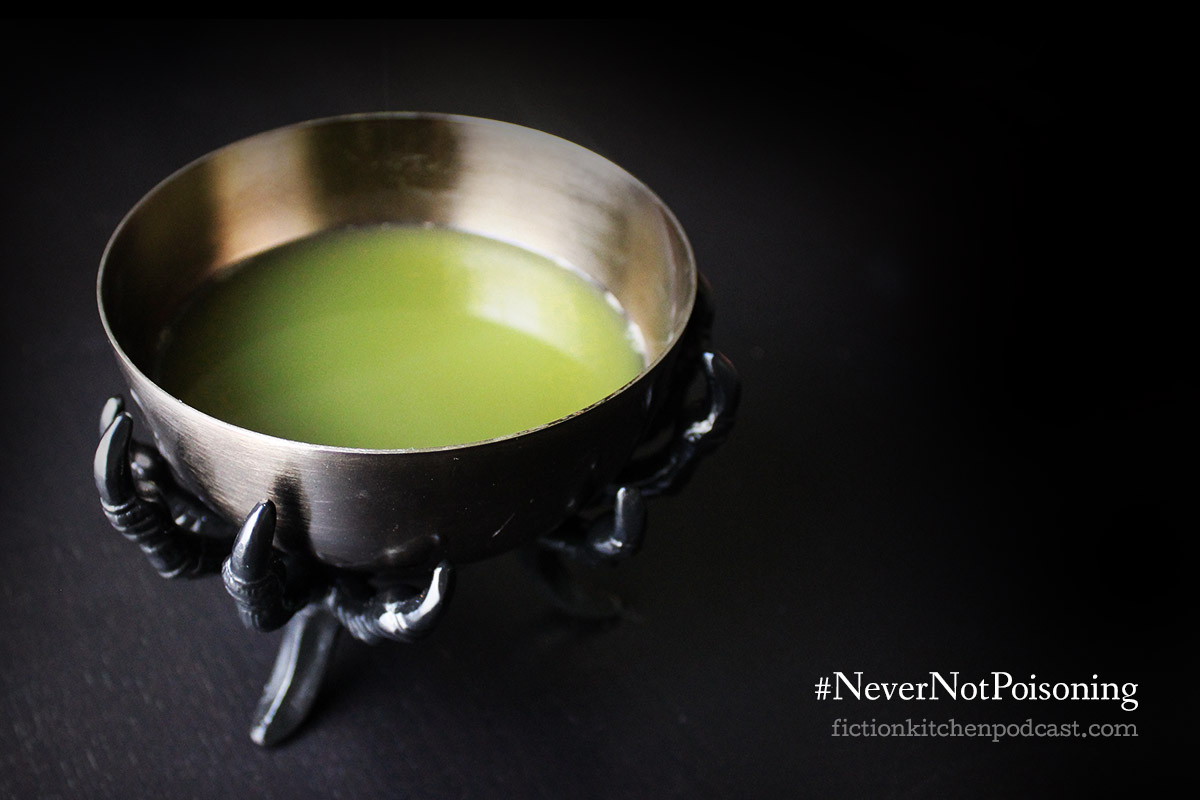
Day-in day-out Sally, #nevernotpoisoning, tries to poison the Evil Scientist using ingredients from her quaint little garden of deadly herbs. On this particular night, she uses her deadly nightshade masked by frog’s breath and worm’s wort.
My version swaps ingredients for each of these – instead of deadly nightshade, an edible nightshade (green pepper), seaweedy dashi for the most pleasant interpretation of frog’s breath, and mirin, a sweet alcohol for the worm’s wort (wormwood is sweet and the main ingredient of absinthe). For the gruesome green shade I added a little matcha.
What was originally a poisonous soup translated to a beautiful restorative broth. Sip on its own or use it to cook a lovely bowl of rice noodles and veggies!
Poisonous Soup
3 cups water
1 2×2 inch square kombu
1/2 a green pepper, cut into large chunks
1 pinch bonito flakes
1 teaspoon mirin
1 teaspoon matcha
Put water in a sauce pan and soak the kombu for at least 30 minutes. Add the green pepper and bring to a boil, then lower to a low simmer for 30 minutes. Remove from heat and add bonito flakes and let stand for 10 minutes.
Strain, and gently warm, stirring in mirin and matcha.
This dish was first posted for Fiction Kitchen Episode 47: THE NIGHTMARE BEFORE CHRISTMAS in which Carrie and Diana discuss the classic Tim Burton Halloween (or is it Christmas?) movie, and all the rotten goodies within. #NeverNotPoisoning
Boys and ghouls, it’s MAY MONSTER MADNESS hosted by Annie Walls. Find more bloodcurdling blogs with the links below!
Bam! Pow! It’s #FoodInComics month, Fandom Foodies theme hosted by Diana @ Fiction Food Cafe – check the linkup or search the hashtag for all kinds of comic-inspired dishes!
Scarlet Witch has become one of my favorite characters in Marvel movies, and her portrayal by Elizabeth Olsen is a lovely balance of fragile, sensitive, and powerful. For a Scarlet Witch-inspired dish, borchst seemed perfect! Vibrantly red (ok, magenta), with eastern European roots, and lots of witchy herbs.
I’m a big fan of beets, and often roast a bunch on the weekend and use them throughout the week in salads, soups, pilafs, etc. The easiest way to do beets is to wash, trim, drizzle with olive oil then wrap them in foil to roast whole, then peel off the skin once they are soft – it’s way easier than trying to peel/chop/grate them raw, which is a miserable pain that will thoroughly dye your hands and cutting board.
This soup is full of vegetables and herbs. Here are some of their witchy correspondences:
Beets: beauty, love, rebirth
Celery, bay leaf, oregano, carrots: psychic powers
your choice of herbs, fresh or dried – definitely recommend bay leaf and a handful of finely chopped dill! I also used a good sprinkle of Herbs de Provence which I usually have on hand, it has a mix of herbs like thyme, basil, marjoram and oregano – this is less “borschty” but more witchy 🙂
salt & pepper to taste
sour cream, more chopped dill to serve
Heat olive oil and butter over medium-high heat. Cook onion until thoroughly golden (but be careful not to burn). Add garlic, celery, and carrots, and cook for a minute or two (until garlic looses its raw smell), then add cabbage and a good sprinkle of salt and pepper. Cook, stirring often, until cabbage is very soft. Add beets and tomatoes, the paprika, and another sprinkle of salt, and cook until tomatoes have completely broken down, are reduced and somewhat jammy.
Puree the whole vegetable mixture in a blender with a cup of water or chicken broth (you will likely have to do this in batches). Return to the pot and add the rest of the water or broth, plus the herbs. Bring to a boil then reduce to a simmer and simmer for 20 minutes or so. Adjust seasoning if necessary.
Serve hot with a dollop of sour cream and a sprinkle of fresh dill.
This dish was first posted for Fiction Kitchen Episode 14: AVENGERS: AGE OF ULTRON in which Carrie and Diana discuss the action-packed Marvel movie including Thor’s magic juice, Black Widow’s burden, showing vs. telling…and apparently when we think Avengers, we think beets??
One of my favorite tales spun by Scheherezade in 1001 Arabian Nights is The Prince and the Large and Lonely Tortoise. This story has everything: animal brides, shape shifting, jealous bitches, cooking trickery, and dinner party drama. If, like the sultan you are dying to hear more, and I’m almost certain you are, the full story in all its public domain glory is below the recipe.
In the story, the lonely tortoise, in her lovely human form, attends the feast. She pours rice swollen in butter over her hair, which turns into pearls, and a thick green soup which turns into emeralds.
This reminded me of a delightful Middle Eastern soup I’ve made several times. It’s an elegant soup with split peas and mint. I feel that it’s pretty representative of the region, with the ubiquitous lentils and very common mint.
In a soup pot, heat olive oil on medium heat. Saute onions and garlic until the onion is soft and translucent. Add the chopped butter lettuce and saute until wilted. Add mint, a generous pinch salt, and a sprinkle white pepper, and stir well.
Add split peas and vegetable stock, bring to a boil, then lower to a simmer. Simmer for about 40 minutes or until split peas are soft. Add mint, and cook another 3 or 4 minutes.
Puree in a blender (hold a tea towel over the top so it doesn’t explode) and pour back into the pot. Taste and adjust seasoning (add more salt) if necessary.
Serve hot with a dollop of whipped yogurt and a sprinkle of chopped mint.
This dish was first posted for Fiction Kitchen Episode 9: ARABIAN NIGHTS in which Carrie and Diana Scherezade’s awesomeness, hedonism vs. moderation, random guests, bedouin hospitality and some light shape shifting.
It is related that there was once, in the antiquity of time and the passage of the age and of the moment, a powerful sultan whom Allah had blessed with three sons: Ali, the eldest, Hussein, the second, and Muhammad, the youngest. They were all indomitable males and heroic warriors; but the youngest was the most handsome, the bravest and the most generous. Their father loved them equally and, in the justice of his heart, had resolved to leave to each an equal part of his riches and his kingdom.
Also, when they came to marriageable age, the king called his wise and prudent wazir to him, saying, “O wazir, I wish to find wives for my three sons, and have called you to me that you may give me your advice.”
The wazir reflected for an hour, and then answered, lifting his head, “O king of time, the matter is delicate, for good and evil chance are not to be told beforehand, and against the decree of destiny there is no provision. I suggest that you take the three princes, armed with their bows and arrows, up to the terrace of the palace, and there, after bandaging their eyes, make them each turn round several times, After that, let them fire their arrows straight ahead of them, and let them visit the houses upon which the arrows fall. Have the owners of the houses brought before you and ask of each his daughter in marriage for the marksman of the arrow which fell upon his house. Thus each of your sons will have a bride chosen by destiny.”
“Your advice is excellent, and I shall act upon it!” cried the sultan.
As soon as his sons returned from hunting, he told them of the trial and led them up, with their bows and quivers, to the terrace of his palace. The dignitaries of the court followed and watched with breathless interest while he bandaged the eyes of the young men
The eldest prince was turned about, and then discharged his arrow straight in front of him. It flew through the air with great swiftness and fell upon the dwelling of a most noble lord. In like manner the second prince’s arrow fell upon the terrace of the commander-in-chief of the king’s army.
But, when Muhammad drew his bow, the arrow fell upon a house whose owner was not known. The king, with his retinue, set forth to visit the three houses, and found the great lord’s daughter and the commander-in-chief’s daughter were girls as fair as moons, and that their parents were delighted to marry them to the two princes. But when the king visited the third house, on which Muhammed’s shaft had fallen, he found in it no inhabitant except a large and lonely tortoise.
Therefore, deeming that there could be no thought for a moment of marrying a prince to such an animal, the sultan decided that the test should be made again. The youngest prince mounted again to the terrace and again shot an arrow blindfold, but it fell true upon the house of the large and lonely tortoise.
The king grew angry at this, and cried, “By Allah, your shooting is not fortunate today, my son! Pray for the prophet!”
“Blessing and peace be upon him and upon his companions and those who are faithful to him!” answered Muhammad.
“Now invoke the name of Allah,” exclaimed the king, “and shoot a third arrow.” “In the name of the merciful, the compassionate!” exclaimed Muhammad, as he strongly drew his bow and sent a third shaft onto the roof of the house inhabited by the large and lonely tortoise.
When the Sultan saw, beyond any manner of doubt, that destiny favored the tortoise, he decided that his youngest son should remain a bachelor, and said to him, “My son, as this tortoise is not of our race, or our kind, or our religion, it would be better for you not to marry at all until Allah takes us again into his compassion.”
But young Muhammad cried in dissent from this, “I swear by the virtues of the prophet (upon whom be prayer and peace!) that the time of my celibacy is over! If the large tortoise is written in my destiny I shall assuredly marry her.”
“She is certainly written in your destiny!” cried the astonished sultan. “But it would be a monstrous thing for a human being to wed with a tortoise!”
“I have no predilection for tortoises in general,” cried the prince. “It is this particular one whom I wish to marry.”
The sultan, who loved his son, made no more objections but, though the weddings of Ali and Hussein were celebrated with great splendor for forty days and forty nights and then felicitously consummated, no one at court, neither his two brothers, nor their wives, nor the wives of the amirs and dignitaries, would accept an invitation to Muhammed’s bridal feast, and, instead, they did all in their power to spoil and make it sad.
Poor Muhammad was bitterly humiliated by the mocking smiles and turned backs which everywhere greeted him; but of his marriage night he would say nothing, and only Allah, from whom no secrets are hid, can tell what passed between the two. It is certain, at least, that no one in that kingdom could imagine how a human youth might couple with a tortoise, even though she were as big as a stock jar.
In the time which came after the three weddings, the years and preoccupations of his reign, added to the emotion of his disappointment in Muhammad, bowed the king’s back and thinned his bones. He pined away and became yellow. He lost his appetite and, with his appetite, his vision, so that he became almost completely blind.
The three princes, who loved their father dearly, resolved to leave his health no longer in the ignorant and superstitious care of the harem.
When they had concerted together, they approached the sultan and kissed his hand, saying, “Dear father, your face is becoming yellow, your appetite is weakening, and your sight is failing you. If these things go on, we shall soon be tearing our garments for grief that we have lost the prop of all our life. Therefore you must listen to our counsel and obey it. We have determined that our wives and not the women of the harem shall henceforth prepare your food, for these last are great experts in the kitchen and by their cookery can give you back appetite which shall furnish strength, strength which will furnish health, and health which will restore your vision.”
The sultan was deeply touched by this care on his sons’ part. “May Allah shower his blessings upon you!” he said. “But I am afraid that this will be a great nuisance for your wives.”
“A nuisance to our wives?” they cried. “They are your slaves and have no more urgent object in life than to prepare the food which will restore you to health.”
“We have agreed that each of them shall prepare a separate dish, and that you shall choose your favorite in appearance, odor, and taste. Thus appetite will come back to you, and your eyes be cured.”
“You know better than I do what is for the best,” answered the sultan, as he embraced them.
The three princes went joyfully to their wives and bade them prepare the most admirable dish they could, and each said further, to excite a spirit of emulation, “It is essential that our father should prefer the cooking of our house.”
After they had given their orders, the two elder brothers were for ever mocking Muhammad and asking him how a tortoise cooked, but he met all their jests with a calm smile.
His wife, the large and lonely tortoise,had only been waiting for such an opportunity to show what she could do. At once she set to work, and her first care was to send a confidential servant to her elder sister-in-law, begging her to send back all the rat and mouse dung which she could collect in her house, that the tortoise, who never employed any other condiment, might use these matters for seasoning the rice dishes which she was preparing for the sultan.
“As Allah lives, I will do no such thing!” said Ali’s wife to herself. “If these things make really good seasoning, let the wretched tortoise find her own. I can make all the use of them that is necessary.” Then aloud to the servant she said, “I regret that I have to refuse your mistress’s request, but I have hardly enough rat and mouse dung for my own requirements.”
When the servant returned with this answer, the tortoise laughed happily, and sent her to Hussein’s wife with a request for all the hens’ and pigeon’s droppings which she had by her. The servant returned from this mission empty handed, with a bitter and disobliging message from the second princess. But when the tortoise had caused the words to be repeated to her, she fell into an ecstasy of contentment and laughed so heartily that she fell over on her backside.
As soon as she was a little recovered, she prepared those meats which she could cook best, covered the dish which held them with a wicker cover, and wrapped the whole in a rose-scented napkin. Then she dispatched her servant with the dish to the sultan, at the same moment as his other two daughters-in-law were sending theirs by slaves.
The time of the meal arrived, and the sultan sat down before the three dishes; but, when he had lifted the lid of that sent by the eldest son’s wife, there rose so foul a steam and odor of rat turds that it might well have asphyxiated an elephant.
The sultan was so disagreeably affected by this stench that he fell head over heels in a swoon, and, when his sons succeeded in bringing him to with rose-water and the use of fans, he sat up and cursed his daughter-in-law heartily.
In a little while he became calmer and consented to try the second dish; but, as soon as it was uncovered, a fetid stink of burnt birds’ droppings took him by the throat and eyes so that he thought that the hour of blindness and death was upon him. It was not until the windows had been thrown open and the dish removed and benzoin burnt with incense to purify the air, that the disgusted old man felt himself strong enough to say, “What harm have I done to your wives, my sons, that they should try to dig me a grave before my time?” The two elder princes could only answer that the thing passed their understanding; but young Muhammad kissed his father’s hand and begged him to forget his previous disappointments in the delight of the third dish.
“What is that, Muhammad?” cried the king in an indignant rage. “Do you mock your old father? When women can prepare such frightful foods, do you expect me to touch the cooking of a tortoise? I can see that you have all sworn to destroy me.”
Muhammad went on his knees and swore, by his life and by the verity of the faith, that the third dish would make up for all, and that he himself would eat anything of it which was not to his father’s taste. He urged with such fervor and humility that the sultan at last signed to the slave to lift the third cover, and waited with a set jaw, murmuring, “I seek refuge in the protection of Allah!”
But it was the soul of all fine cooking which rose from the dish that the tortoise had prepared. It exquisitely dilated the fans of the old man’s heart, it nourished the fans of his lungs, it shook the fans of this nostrils, it brought back lost appetite, it opened his eyes and clarified his vision. He ate for an hour without stopping, then drank an excellent sherbet of musk and pounded snow, and finally gurked several times from the very bottom of his satisfied stomach.
In great delight he gave thanks to Allah and praised the cooking of the tortoise. Muhammad accepted his congratulations modestly, in order not to excite the jealousy of his brothers. “That is only one of my wife’s talents, dear father,” he said. “Allah grant that she may some day find a chance really to earn your praises.” Then he begged the king to allow his future nourishment to be entirely in the hands of the tortoise, and his delighted father readily agreed to the arrangement, which in a few weeks entirely reestablished his health and eyesight.
To celebrate his cure the sultan gave a great feast, and bade his three sons attend it with their wives. At once the two elder princesses began to make preparation that they might appear with honor and success before their father-in-law.
The large tortoise also schemed how to whiten her husband’s visage before the people by the beauty of her escorting and the elegance of her clothes.
Her first step was to send her confidential servant to Ali’s wife with a request for the loan of the big goose which she had in her courtyard, that the tortoise might use it as a fitting steed on which to ride to the festivities. The princess gave so peremptory a refusal that the good tortoise fell over on her backside in the convulsions of laughter which it occasioned her.
Then she sent to the second sister to borrow her large he-goat for the same purpose, and never has the tortoise been so convulsed and dilated with pure joy as was this one when she received a second and much ruder refusal.
The hour of the feast came. The old queen’s women were drawn up in good order at the outside door of the harem to receive the three royal brides. As they waited, a cloud of dust rolled towards them. When it dissipated, they saw a gigantic goose waddling forward with the speed of the wind, throwing her legs to left and right, beating her wings, and carrying the first princess of the kingdom clinging to her neck in disordered fright. Almost immediately afterwards, a he-goat, rearing and savagely bleating, came up to the entrance. It bore upon his back the second princess, all stained with dust and dung. The sultan and his wife were deeply offended by this double exhibition. The former cried, “See, they are not content with strangling and poisoning me; they wish to mock me before the people!”
The queen received the two women coldly. An uncomfortable pause was only broken by the arrival of the third princess. The king and his wife were full of apprehension. They said to each other, “If two humans could show so absurdly, what can we expect from a tortoise? There is no power or might save in Allah!” So saying, they waited with caught breath for what might appear.
The first rank of couriers appeared, announcing the arrival of prince Muhammed’s wife. Presently four handsome grooms, dressed in brocade and rich tunics with trailing sleeves, led up the palanquin. It was covered with bright-colored silks, and the black men who carried it set it down by the stairs. An unknown princess of bright splendor stepped from it, and the women, supposing her to be a maid of honor, waited for the alighting of the tortoise. Yet, when the palanquin was borne away, and this delightful vision mounted the steps alone, they recognized her as Muhammed’s bride and received her with honor and effusion. The sultan’s heart rejoiced to see her grace and nobility, her charming manners and musical movements.
At once the sultan bade his sons and their wives be seated by him and by the queen, and, when they had taken their places, the feast was served.
The first dish was, as usual, a profusion of rice swollen in butter. Before anyone could take a mouthful the beautiful princess lifted the dish and poured all its contents over her hair. Immediately each grain of rice turned to a pearl, and the pearls ran down the long strands of hair and tinkled to the floor in a bright cascade.
Before the company could recover its wits after so admirable a prodigy, she also lifted a large tureen, filled with thick green soup, and poured its contents over her head in the same way. The green soup changed to an infinity of emeralds among her hair. These fell about her like green rain, to mingle their sea-tints with the pearls upon the floor. During the delighted confusion which followed, the servants brought other supplies of rice and green soup for the guests to eat. The two elder princesses, now yellow with jealousy, could not leave well alone. The eldest seized on the dish of rice and the second on the tureen of green soup; both poured the contents of these things upon their heads. But the rice remained rice in the hair of the first, horribly daubing her with butter. The soup, remaining soup, ran down in a sticky course over the hair and face and garments of the second, for all the world like cow slop.
The sultan was disgusted at these accidents and commanded his two elder daughters-in-law to withdraw from the feast. Also he proclaimed that he wished never to see them again, or smell them, or hear of them. Their husbands, therefore, led them away in a great rage. You may suppose that all four noses trailed very near the ground. So much for them.
When prince Muhammad and his magic princess were left alone with the sultan, he embraced them and took them to his heart. He said “You alone are my children!” He wrote a will leaving his throne to his youngest son. Calling together his amirs and wazirs, he made his intention known to them. Then to the two young people, he said, “I wish you both to stay with me in my palace until the end.”
“To hear is to obey,” they answered. “Our father’s desire is upon our heads and before our eyes.”
That she might never again be tempted to resume the appearance of a tortoise and so shock the old sultan, the princess ordered her servant to bring the large and lonely shell which she had left at home that day and, when it was fetched, burnt it without compunction. Ever afterwards she remained in her own delightful form. And glory be to Allah who gave her a faultless body, a marvel to the eyes of men!
The giver showered his blessings upon these two and delighted them with numerous children.
As reality and dystopian fiction become closer to indistinguishable, it’s no surprise that it is #DISHTOPIA Month: Eat Like It’s the End of the World, Fandom Foodies theme hosted by the lovely Catherine at The Gluttonous Geek – check out the linkup for more foodpocalypse!
For the Hunger Games, unless you’re really into fried squirrel or nettle tea, the best food is going to be found in The Capitol. Obscene feasts are thrown regularly from the wealth of resources flowing in, which probably include spices, so when I set out to make the creamy pumpkin soup sprinkled with slivered nuts and black seeds that Katniss samples, that’s exactly what I imagined.
I used canned pumpkin (LAZY! Like Capitol people) and a whole can of coconut milk (RICH and DECADENT! Like Capitol people).
Paanch phoran, or five-spice powder, is made from cumin, fenugreek, fennel, mustard, and black seeds called kalonji (or nigella seeds, or onion seeds, or black seeds, etc. It’s the seed of many names), so that’s what I used as the seasoning for my soup. I much recommend seeking out the curry leaves (NOT bay leaves, even though they look similar) at your local Indian market, they will give your soup a delicate and delicious fragrance and really take it to Capitol level fare.
May the soup be EVER in your flavor…
Capitol Pumpkin Soup
2-3 tablespoons coconut oil (or a flavorless cooking oil)
1 onion, diced
1 inch ginger, chopped
2 garlic cloves, chopped
1/2 teaspoon each cumin, fenugreek, fennel, mustard, and kalonji seeds
1/2 teaspoon turmeric
1/2 teaspoon red chili
3 tablespoons ground almonds or almond meal
1 can pumpkin puree
4 cups vegetable broth
1 can coconut milk
1 cinnamon stick
4-5 fresh curry leaves
sliced almond and a sprinkle of kalonji for garnish
Heat the oil and saute onion until it just starts to turn golden. Add ginger and garlic and stir for a minute or two, then add all seeds and cook until they start to sizzle (be careful not to burn). Add turmeric and red chili, stir for a minute, then add almond meal, pumpkin puree and a cup of the chicken broth. Heat through.
Blend the mixture thoroughly and return to the pot along with the rest of the chicken broth, the coconut milk, cinnamon stick, and curry leaves. Mix well, gently heat and cook on a low simmer for about 20 minutes. Serve hot, garnished with sliced almonds and kalonji.
This dish was first posted for Fiction Kitchen Episode 25: THE HUNGER GAMES in which Carrie and Diana discuss The Hunger Games books and movies, including from Greek mythological child sacrifices, Katniss’s practical hairstyle, social commentary, and the scarcity of goat milk.